Updated: 11 November 2026
Five Moroccan deserts side by side
Search for a Morocco desert and you will meet landscapes that share little beyond the word: true dune seas, rocky plateaus and cracked plains. The table puts each place in context. Distances are approximate and shift with your starting point and the state of the tracks.
| Place | Where it is | Atmosphere | Terrain | Usual format |
|---|---|---|---|---|
| Merzouga and Erg Chebbi | Far east, by the Algerian border; Erfoud lies roughly 60 km away | Busy, with many camps along its edge | A dune ribbon about 28 km by 5–7 km, reaching around 150 m in places | One stop on a multi-day tour, often from Fes or Marrakech |
| Erg Chigaga (Chegaga) | About 55 km south-west of M’Hamid El Ghizlane, or approached from the west via Foum Zguid | Remote and quiet | Morocco’s largest erg, 35–40 km long and 15 km wide; most dunes 60–80 m | A night on site; a day trip is possible from Foum Zguid |
| Tinfou and the Draa valley | Some 26 km south of Zagora | Easy to reach, so lively | A small dune patch on a rocky plateau | A stop or day outing from Zagora or Ouarzazate |
| Agafay | About 30 km south of Marrakech, 45 minutes to an hour by road | Popular for an evening out of Marrakech | Stony reg with no real dunes, facing the High Atlas | Half a day, a camp dinner or a night |
| Foum Zguid desert | On the N12 between Tata and Zagora; Ouarzazate is about 150 km away via Tazenakht | Peaceful, off the main routes | The Lake Iriki plain, the Erg Lmhazil dunes and the western approach to Erg Chigaga | From a one-day 4×4 outing to a trek of several days |
For any transfer from a big city, ask your operator to confirm the driving time in writing.
Erg Chigaga or Merzouga: two dune seas, two moods
Both are genuine ergs, but you feel the gap in how you arrive. At Merzouga, hotels and camps stand along the dunes and you can almost drive to the foot of the sand. At Chigaga you spend hours on a 4×4 track. That distance acts as a filter, and at night the silence belongs to a desert that was never designed for crowds.
- Merzouga fits when your route goes through Fes and the east, or when you would rather avoid tracks.
- Erg Chigaga suits travellers who value remoteness and accept a proper crossing from Marrakech, Agadir, Ouarzazate, Zagora or Foum Zguid.
- The Foum Zguid approach runs through Iriki National Park, scenery you do not see when arriving from M’Hamid.
Dunes, camps and the night sky are covered in our Erg Chigaga guide.
Agafay and Zagora: handy when time is short, but not dune seas
Many “desert from Marrakech” offers end at Agafay or near Zagora. Both work for a short stay, provided you know what to expect.
- Agafay is a plateau of reddish stones, good for a sunset, a tented dinner or a quad ride. Do not expect big dunes; there are none.
- Zagora and Tinfou bring the Draa valley and its palm groves, but the Tinfou dunes are modest and see a lot of traffic.
If you want sand to the horizon without leaving the Draa area, the two-day Zagora to Erg Chigaga and Foum Zguid circuit (from €225) links the valley to the big dunes.
The Foum Zguid desert: a quiet way into Chigaga
Foum Zguid (also spelt Foum-Zguid) is a small oasis town below the Jebel Bani, in Tata province. Just beyond its last houses lies Iriki National Park (Iriqui), established in 1994 and covering about 123,000 hectares. At its heart, Lake Iriki is usually a dry, pale lake bed; after exceptional rain a shallow sheet of water can appear, as has happened in recent years.
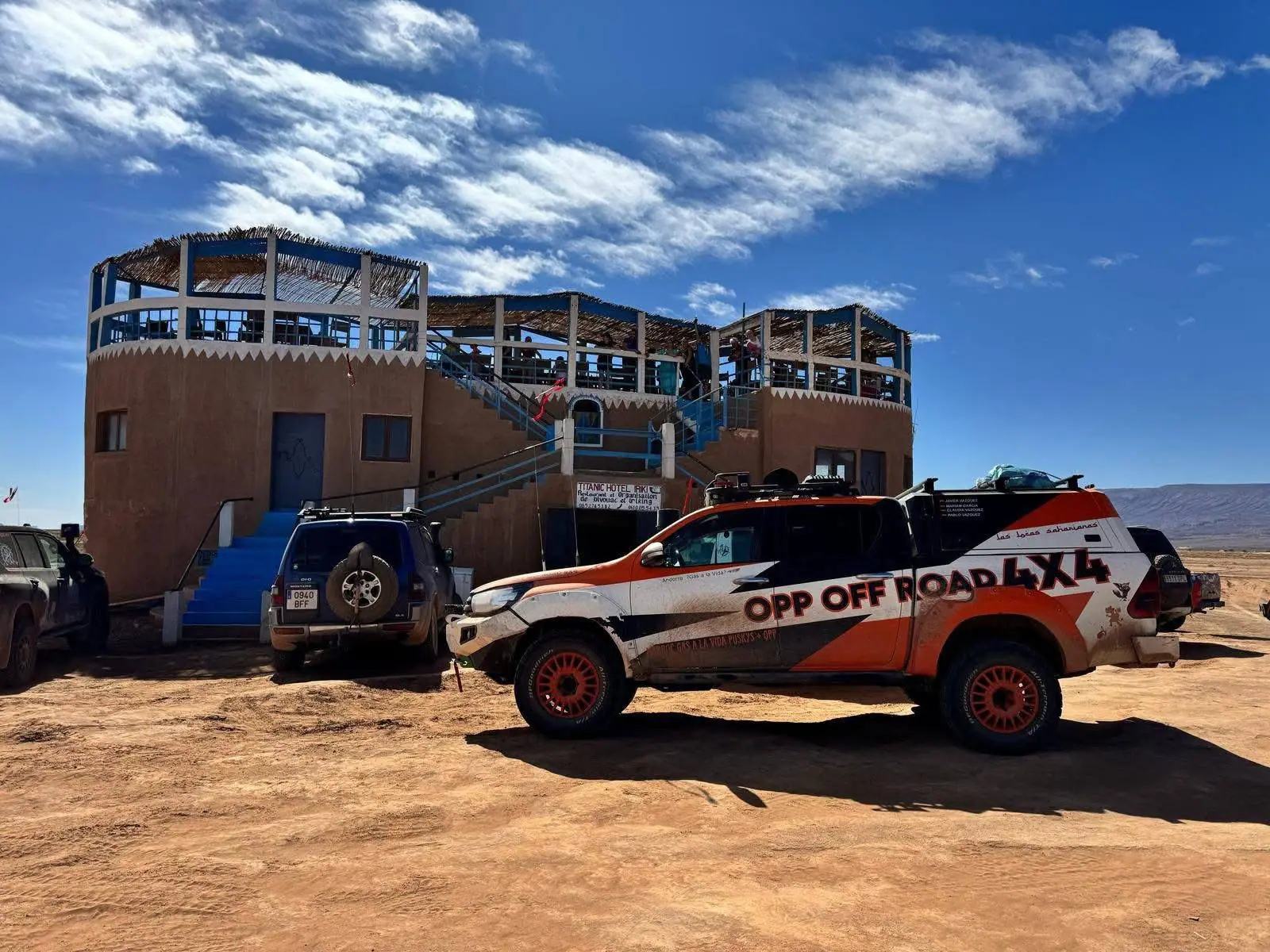
The track to the Chigaga dunes crosses this plain and takes 2.5 to 3 hours behind the wheel, depending on stops. Along the way you pass three landmarks:
- Titanic Iriki, an inn shaped like a ship, stranded in the middle of the plain;
- Erg Lmhazil (El Mhazil), a smaller and quieter dune field made for walking and camping;
- and finally the crests of Erg Chigaga at the end of the crossing.
This route suits travellers coming from Agadir, Tata or Ouarzazate who would rather skip the crowded areas. All our trips are gathered on the Foum Zguid desert page.
Which desert for which traveller?
Rather than ask for the “best” desert, start from what you want out of a night in the sand.
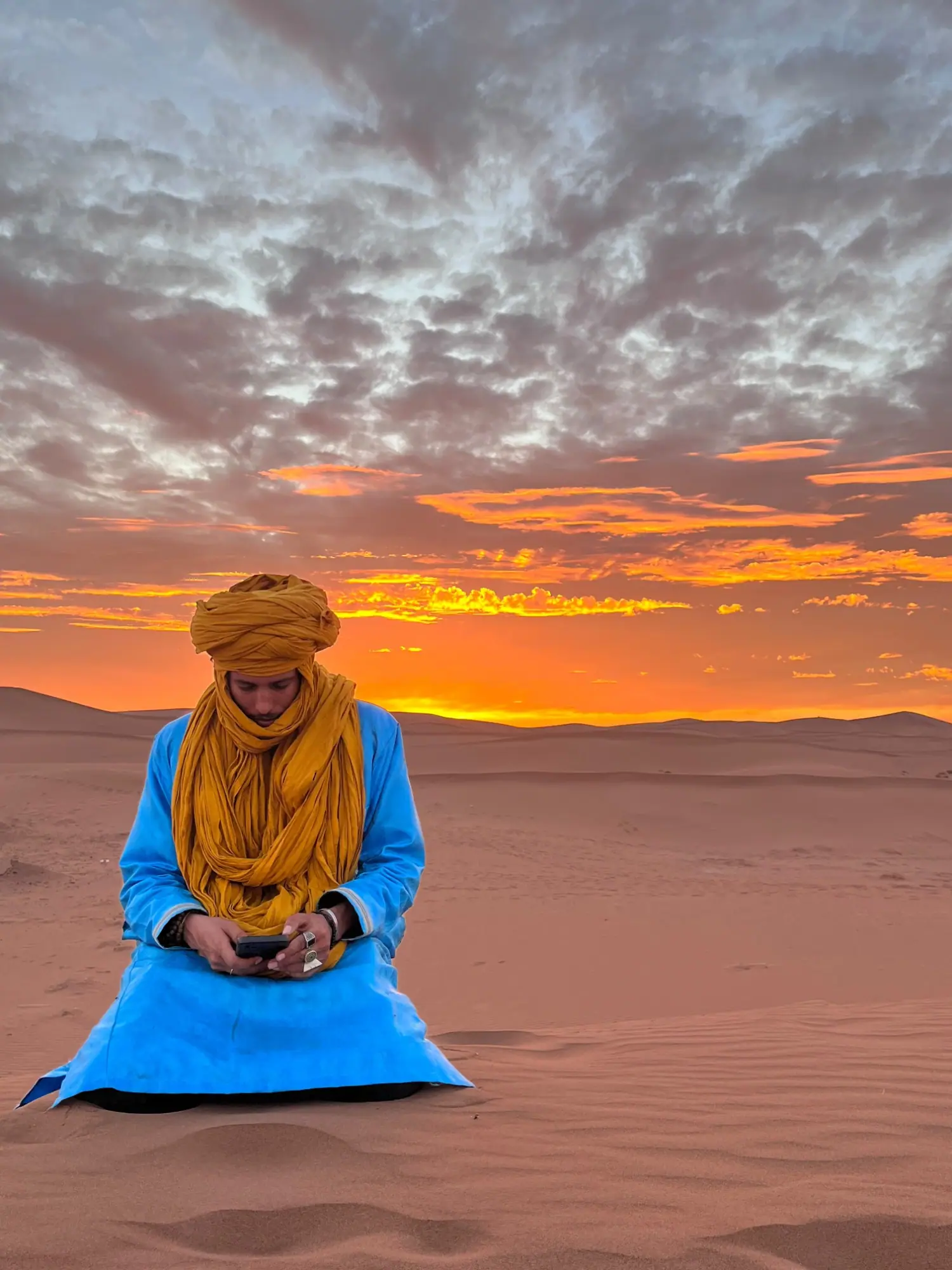
- Silence and a starry sky: Erg Chigaga or Erg Lmhazil, far from any light.
- Two days in Marrakech: Agafay, accepting that there are no dunes.
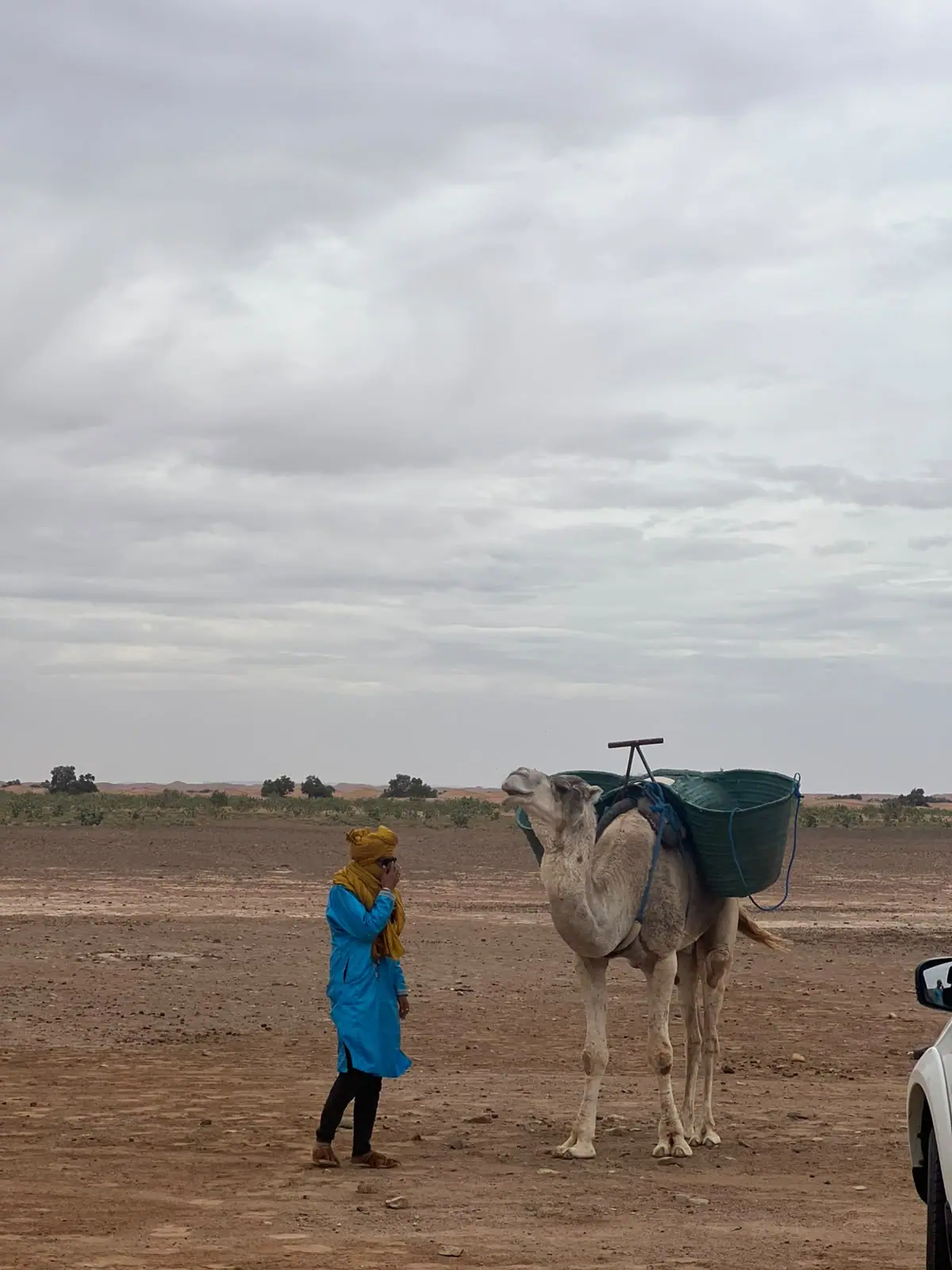
- You love walking: the Foum Zguid desert, with its on-foot stages, gentle dunes and camels to carry the luggage.
- Travelling with children: a short outing from Foum Zguid, with no long transfers.
- Following the Fes road: Merzouga, the natural fit for that route.
When to go: the desert through the seasons
The Moroccan desert is best visited from roughly October to April. In high summer afternoons often pass 40 °C; in midwinter nights can approach freezing. The notes below are qualitative and vary from year to year.
| Period | What it feels like | Advice |
|---|---|---|
| October and November | Mild days return, cool nights | A very good window for camping and walking |
| December to February | Kind days, cold nights, sometimes near 0 °C | Bring a fleece and blankets; book early for the holidays |
| March and April | Lovely weather, but wind rises and sandstorms become likelier | Start early and carry a scarf |
| May | Heat begins to settle in | Keep outings brief and at cooler hours |
| June to August | Frequently above 40 °C in the day | Skip the walking and ask for an adapted plan |
| September | Still hot, easing toward the end | A 4×4 outing may work, weather permitting |
In your bag: what you really need
The desert swings between heat and cool, and sand gets everywhere. Pack light.
- A soft bag rather than a rigid suitcase.
- Loose, covering clothes, plus a fleece or down jacket for the evening.
- A scarf or hat, sunglasses and sun cream.
- Closed shoes for walking, sandals for the dunes.
- A head torch, a power bank and a waterproof pouch to shield electronics.
- Any personal medication.
Ask beforehand what the camp provides: blankets, toilets, a power socket.
Travelling with children or older relatives
The desert works well for families when the pace is chosen with care. It is long roads that tire people, not dunes: starting from Foum Zguid shortens the transfer, and a day or a single night makes a good trial before something longer.
- Give the children’s ages so the guide can shape stops and activities.
- Pack an extra warm layer for the evening.
- The camel ride in our programmes often lasts about an hour; ask whether it suits the youngest.
- For an older traveller or anyone with limited mobility, say so in advance: the track is bumpy and climbing a dune takes energy.
How to tell two desert offers apart
Two listings that look alike can hide very different services. Ask these questions before you pay:
- Is the programme detailed day by day? Times, stops, nights, bedding.
- Private or shared?
- What does the price cover? Meals, water, camel, tent: get it in writing.
- Who drives and who guides? For Chigaga, choose someone who knows the track.
- What are the payment and cancellation terms?
- Can the reviews be checked?
A good trip also respects the place: take your rubbish with you, stay on the tracks and ask before photographing anyone.
How many days should you allow?
Starting in Foum Zguid, a single day is enough to climb a dune; two days add a night at camp, and from three days you can walk. From a big city, add the transfer.
- 1 day: the one-day Erg Chigaga outing (from €100), or a day on Lake Iriki with lunch at the Titanic (from €80).
- 2 days: a night camping at Chigaga (from €140).
- From Marrakech, Agadir, Ouarzazate or Zagora: see our circuits of 2 to 7 days.
- On foot: the desert trekking guide describes formats of 3 to 7 days.
Compare the short trips on the Foum Zguid desert excursions page, and book through the contact page.
Travellers’ questions
Which is the most authentic desert in Morocco?
That depends on what authentic means to you. Merzouga offers tall dunes and plenty of comfort; Agafay is a stony expanse near Marrakech. Erg Chigaga, the country’s largest erg, remains the most remote. You reach it by track from M’Hamid or from Foum Zguid, and you meet far fewer people there.
Should I pick Merzouga or Erg Chigaga?
Merzouga makes sense if your route follows the east: access is simple and accommodation plentiful. Erg Chigaga suits those leaving Marrakech, Agadir, Ouarzazate, Zagora or Foum Zguid who want somewhere isolated, reached by 4×4. Both are true ergs; the real difference lies in access and crowds.
What is the best season to sleep in the desert?
Roughly October to April. Days are pleasant then, but winter nights can approach 0 °C, so bring warm layers. In summer afternoons often pass 40 °C and walking becomes hard. In spring the wind can lift sand, so a scarf comes in handy.
Are there real sand dunes near Marrakech?
No. Agafay, about 30 km south of Marrakech, is a stony desert without big dunes. For real sand you need Erg Chigaga or Merzouga, which means at least two days from Marrakech. Our trek in the heart of the dunes, from €640, starts in Marrakech or Agadir.
Do I need a 4×4 to reach Erg Chigaga?
Yes. The dunes lie at the end of a track: about 55 km from M’Hamid, or across the Lake Iriki plain from Foum Zguid, which takes 2.5 to 3 hours depending on conditions. It is wiser to hire a driver-guide who knows the area than to attempt it in a rental car.
How much does a trip in the Foum Zguid desert cost?
Per person, the Lake Iriki day starts from €80, the day to the Chigaga dunes from €100, and the two-day option with a night at camp from €140. The programme and price are confirmed with you on WhatsApp before you book anything.
Is Foum Zguid a good starting point for Chigaga?
Yes, especially if you arrive from Tata, Agadir or Ouarzazate. Foum Zguid sits on the N12 and opens onto Iriki park, with no need to pass through M’Hamid. The track takes 2.5 to 3 hours by 4×4; a night on site lets you enjoy sunset and the stars.