Updated: 11 November 2026
A white plain before the Chigaga dunes
Drive east out of Foum Zguid and the tarmac soon runs out. Stones turn to sand, then everything flattens: this is Lake Iriki, a pale expanse of salt crust and cracked clay where the horizon never seems to get any closer. The silence is total, and for many visitors it is the first real picture of the Foum Zguid desert.
Nearly everyone heading for Erg Chigaga (sometimes spelt Chegaga) crosses it without stopping. That is a pity. The low light at dawn and dusk is superb, and the plain is easy to explore at a gentle pace, stepping out to walk on the fissured ground or photograph the far-off ridges.
Where Iriqui National Park lies
Iriki (Iriqui) National Park was created in 1994 and spreads over roughly 123,000 hectares, wedged between the former bed of the Draa and the first ridges of the Anti-Atlas. It overlaps the provinces of Tata and Zagora; the regional tourist board puts it about 140 km north-east of Tata.
- Gateway: Foum Zguid, a small oasis town under the Jebel Bani on the N12 between Tata and Zagora.
- From Ouarzazate: about 150 km by road via Tazenakht to Foum Zguid, before the tracks begin.
- Direction: the lake sits on the line to the Chigaga dunes, so the two fit into one trip with no detour.
Dry most of the time, briefly wet after exceptional storms
Do not picture a sheet of water. In the vast majority of visits Lake Iriki is a flat bed of sand, clay and salt. After heavy storms a skin of water a few centimetres deep can settle for a while and form a short-lived wetland; bringing that habitat back was one of the aims behind the park.
The September 2024 storms made headlines. CBS News, running an Associated Press report on 12 October 2024, said NASA satellites showed water in a lake described as dry for some fifty years. It was a rare event, and the water did not stay.
What it means for your outing
- In an ordinary year you walk on firm, dry ground.
- After big storms the bed can become a mud trap and some tracks are closed off.
- Before booking, ask us about the lake: we reply on WhatsApp with what is being seen on the ground around your dates.
Terrain, wildlife and mirages around the lake
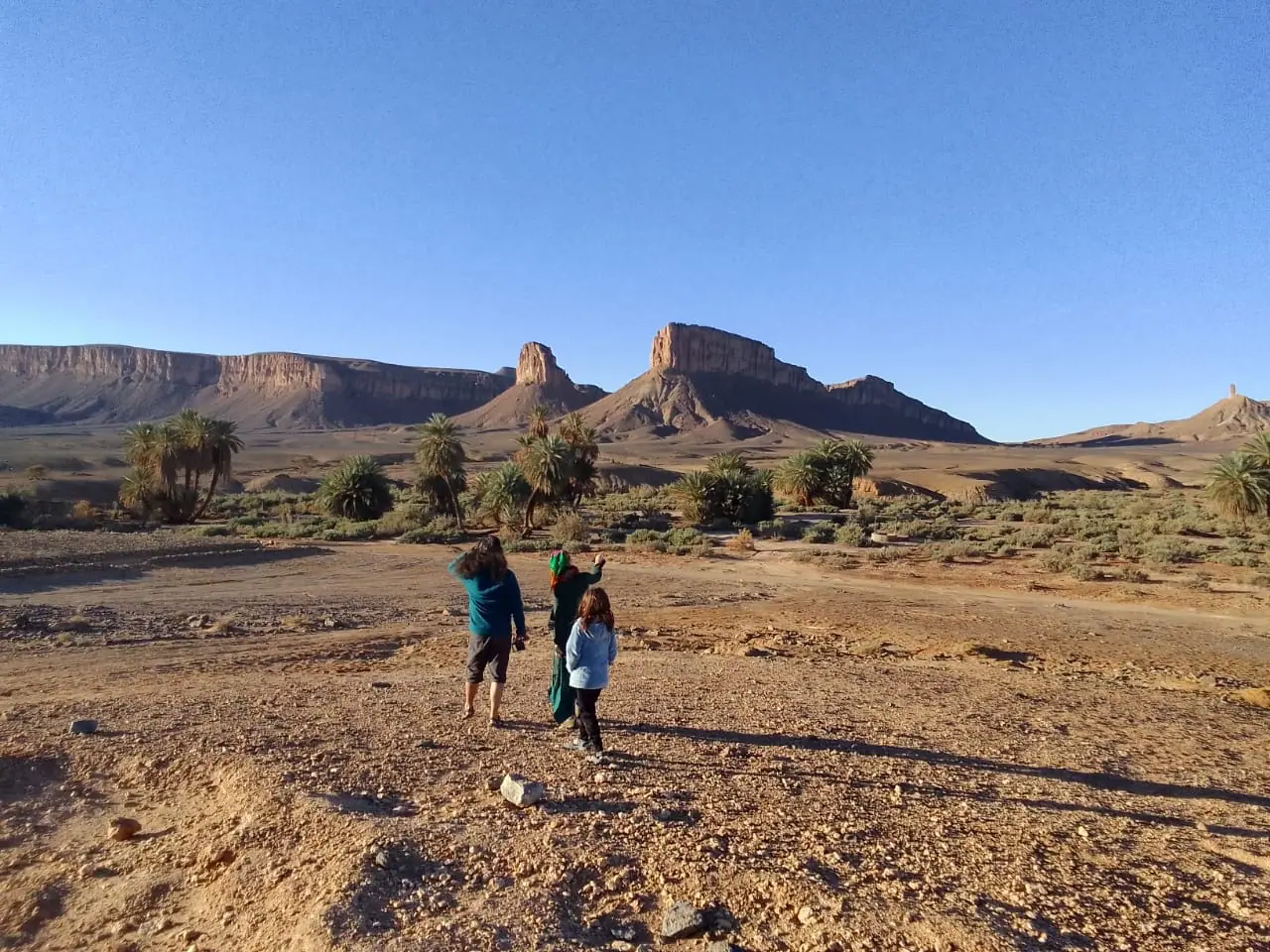
Around the plain the park strings together ochre hills, flat-topped mesas, ribbons of dunes (about half of the territory, according to the tourist board), wooded steppe and acacia savannah. Tamarisk, a shrub that tolerates both drought and salt, holds some of the dunes in place.
On hot days the trembling air blurs the skyline and conjures false pools of water: a mirage, and often the picture visitors say they remember best.
Wildlife
For mammals and birds, official sources name the dorcas gazelle, the Barbary sheep, the striped hyena and the houbara bustard (listed as vulnerable), along with monitor lizards, chameleons, geckos and horned vipers. All are wary, so no sighting is promised. In winter, if a little water lingers, flamingos, coots and geese may drop in.
A few families still live in the park and Iriki remains an important grazing area. Keep your distance from their tents and ask before photographing anyone.
The Titanic Iriki stop
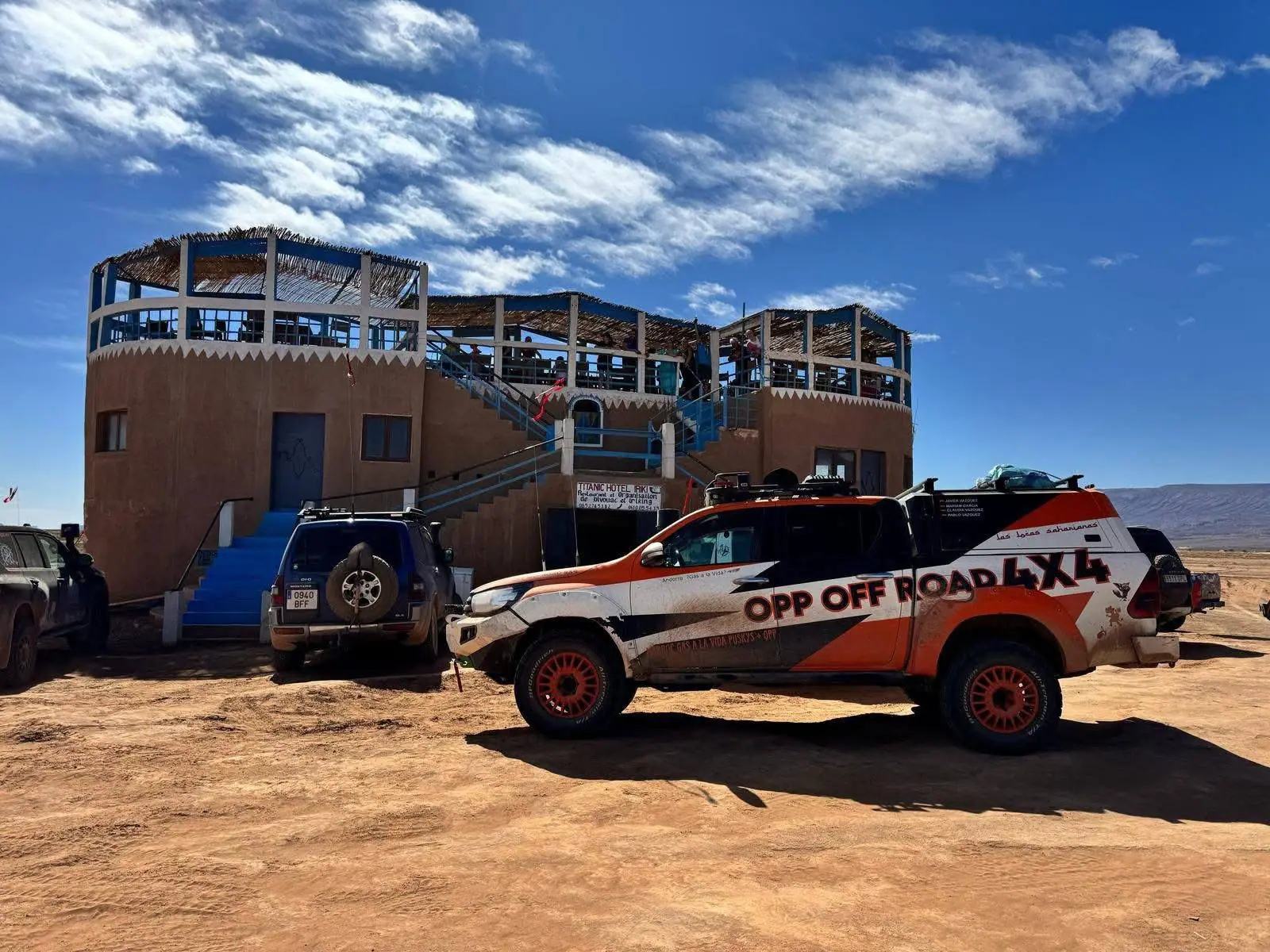
Out on the plain stands Titanic Iriki, a mud-brick auberge shaped like a ship that has run aground in the desert. Its shaded terrace makes a welcome break before you rejoin the track.
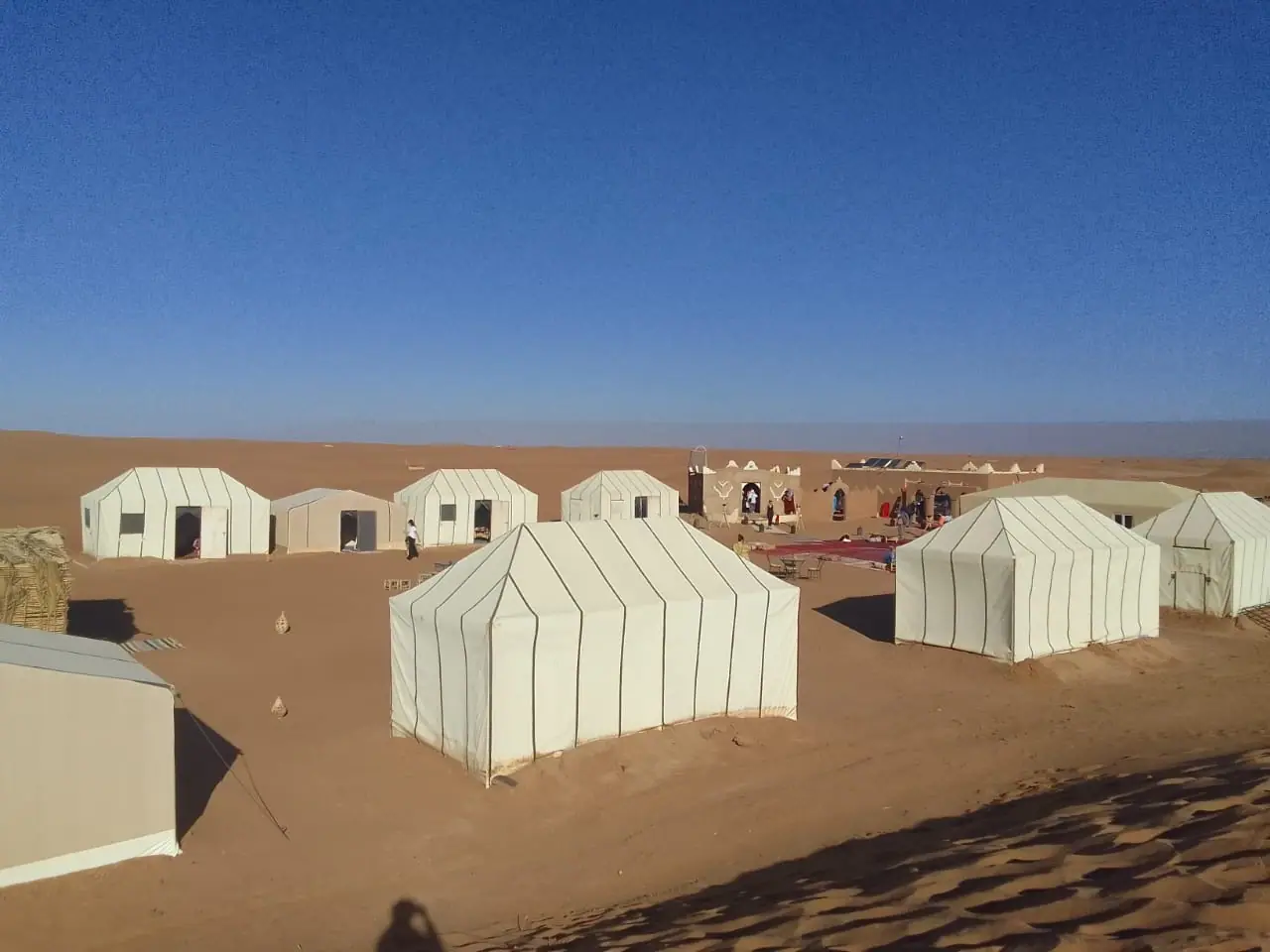
With us it is the lunch stop on the Titanic Iriki and Lake Iriki day trip. On the Titanic Iriki overnight option you have a Moroccan dinner and then sleep, under the stars or in a mud-brick room, before sunrise over the plain. The three-day circuit to Chigaga also spends its first night there, after about 60 km of track from Foum Zguid.
The 4x4 track: what to know before you go
The regional tourist board is clear that a 4x4 is compulsory in the park. The first kilometres are stony, then come sandy stretches and finally the plain, where tracks cross and look alike. Mobile coverage is patchy. A local guide who follows ground conditions spares you both sand and mud; a lone hire car has no business out here.
| Leg | Indicative time on track |
|---|---|
| Foum Zguid to the Chigaga dunes | about 2.5 to 3 hours, depending on the ground and stops |
| Foum Zguid to M’Hamid El Ghizlane through the park | 5 to 6 hours, per the tourist board |
| Foum Zguid to Titanic Iriki (3-day circuit) | about 60 km of track |
A typical outing takes in salt flats, cracked ground, rock formations and viewpoints; some itineraries add a fossil site. Starting further away? Our Morocco desert circuits from Ouarzazate, Zagora or Agadir also cross the lake.
Choosing your trip: day out, night or trek
Every departure is private and leaves from Foum Zguid with Abdul, a local guide. We agree the route and the price with you before you commit.
| Price | Trip | Length | What you get |
|---|---|---|---|
| from €80 | Titanic Iriki and Lake Iriki | 1 day | The plain, photo stops, lunch at Titanic Iriki |
| from €130 | Lake Iriki, Titanic and camp | 2 days / 1 night | Exploring, lunch, dinner and a night there, first light |
| from €300 | Iriki park trek | 4 days / 3 nights | Crossing the lake, dune walking with camels, nomad oasis |
- Only one day to spare: the Titanic Iriki day trip.
- Want a night sky and silence: the night at Titanic.
- More of a walker: the four-day trek.
Other trips cross the plain too: the return day trip to Erg Chigaga from Foum Zguid (from €100), the two-day Foum Zguid desert stay (from €120) and the Erg Lmhazil camp (from €130). To walk for longer, open our page on trekking in the Moroccan desert; everything is listed in the excursion catalogue.
Seasons at Lake Iriki
October to April is the preferred window. In summer the thermometer often passes 40 °C: a dawn outing is feasible, but the plain offers no shade at all.
| Conditions | Months | Worth knowing |
|---|---|---|
| Warm to mild days | October – November | After rain, check the state of the tracks |
| Pleasant days, nights near freezing | December – February | Bring a warm layer to sleep in; birds possible if water remains |
| Comfortable temperatures | March – April | Sandstorms can occur in spring |
| Very hot, often above 40 °C | May – September | Set out early, walk in the cool hours |
Preparing for a day in Iriqui National Park
- In your bag: hat, sunglasses, sun cream, a scarf for wind and dust, lots of water, closed shoes.
- For a night out: a fleece or light down jacket, head torch, power bank.
- Cash: withdraw some in Foum Zguid or before you leave.
- On the ground: take your rubbish away, keep to existing tracks, leave fossils where they lie.
To see where the lake fits among Morocco’s other destinations, read our comparison Morocco’s deserts: Chigaga, Merzouga or Foum Zguid and the page on the Foum Zguid desert. Any question? Write to us here or on WhatsApp at +212 649 598 615.
Travellers’ questions
Where is Lake Iriki?
It occupies the centre of Iriki National Park in southern Morocco, between the provinces of Tata and Zagora. The closest village is Foum Zguid, which is where the tracks begin. Because the lake lies on the route to the Chigaga dunes, a single trip can combine both landscapes.
Is there water in Lake Iriki?
Seldom. Most of the time it is a dry plain of salt and cracked clay. After freak rainfall, such as the September 2024 storms covered by international media, a thin film of water can form for a spell, though it does not last. Ask us what the situation is on your travel dates.
Is a 4x4 essential for Lake Iriki?
Yes. The regional tourist board requires one in the park because of stony tracks, sandy sections and a lakebed that turns to mud after rain. Add criss-crossing tracks and unreliable mobile signal, and travelling with a local guide who knows the ground makes good sense.
What does a Lake Iriki trip cost?
The one-day Titanic Iriki and Lake Iriki trip begins from €80 per person, lunch included. Staying a night there starts from €130, and the four-day trek in the park from €300. Each itinerary and price is confirmed before you book.
What is there at Titanic Iriki?
It is a mud-brick auberge on the plain, with a ship-shaped design and a shaded terrace. People stop for lunch while crossing the park, and you can also sleep there, either under the open sky or in a traditional room.
When should I visit Lake Iriki?
From October to April, when days are mild. Winter nights sometimes drop towards freezing; in summer, highs often exceed 40 °C. After a spell of heavy rain, particularly in autumn, have the tracks checked, as the lakebed can bog a vehicle down.
Can I link Lake Iriki with Erg Chigaga?
That is the usual way: from Foum Zguid the track cuts across the Iriki plain and reaches Chigaga after roughly 2.5 to 3 hours, depending on the terrain. The day return (from €100) and our two- and three-day camps follow this line.