Updated: 11 November 2026
Foum Zguid on the map: beneath the Jebel Bani
You will see it written Foum Zguid or Foum-Zguid. This southern Moroccan town belongs to Tata Province (Souss-Massa region) and spreads out at about 760 m above sea level, tucked against the Jebel Bani, the long dark ridge that cuts across the whole region. The Arabic name means the mouth of the Zguid wadi.
The N12 runs through it, with Tata one way and Zagora the other, while a separate road climbs north through Tazenakht to Ouarzazate. Beyond the last houses the tarmac stops and Iriki National Park (Iriqui) begins, where only 4×4 vehicles can travel. At the 2004 census the town had just under 9,600 inhabitants, second in the province after Tata.
The main thing to know is that Foum Zguid is a launch pad. You arrive, load water and food, then head for the Foum Zguid desert, with Chigaga (also spelt Chegaga) as the goal.
Getting there: roads from Ouarzazate, Zagora, Agadir and Marrakech
The town has no airport; the practical ones are Ouarzazate, Marrakech and Agadir, and you cover the rest by road. Treat the figures below as rough guides, since stops, roadworks and weather all change the real time.
| Starting point | Rough distance or time | Which way you go |
|---|---|---|
| Ouarzazate | About 150 km | South through Tazenakht |
| Zagora | About 120 km | N12, heading west |
| Tata | About 70 km to Tissint (1 hour), then roughly another hour | N12, heading east via Tissint |
| Agadir | About 390 km, nearly 6 hours | Taroudant, Taliouine, then Tazenakht |
| Marrakech | A long day at the wheel | Tizi n’Tichka pass, Ouarzazate, Tazenakht; many split the drive in Ouarzazate |
A standard car copes with the road to Foum Zguid. After that the tracks are unmarked, with soft sand giving way to stones, so you need a 4×4 and someone who knows the ground. If you plan to use buses or shared grand taxis, ask the day before in Ouarzazate, Zagora or Tata, because timetables shift and seldom appear online.
If you would rather not drive, three private tours begin in a larger city and pass through Foum Zguid: Ouarzazate to Erg Chigaga in two days (from €290), the loop that starts in Zagora (from €225) and the three-day route from Agadir via Taroudant (from €410).
Half a day in town, before or after the dunes
Do not expect monuments. Foum Zguid is a working oasis, and that is much of its charm. A few hours will do.
- The Thursday souk: the day the town fills up. It is liveliest in the morning, when farmers and families from nearby villages come to buy and sell.
- The palm grove: shaded paths that suit the end of the afternoon. Stay on them, because every garden is tended by a family.
- The kasbah ruins: a few earthen walls on the edge of town. Admire them from the ground rather than climbing.
- Crafts: since 2022 a centre has housed workshops for carpets, leather and jewellery, and cooperatives weave carpets and basketry. Buying here pays the makers directly.
- The main street: grocers and cafés, where you pick up water and biscuits before the track.
Around Foum Zguid: Lake Iriki, the ergs, oases and a ksar
The real reasons for the journey start a few dozen kilometres away:
- Iriki National Park, established in 1994, covers about 123,000 hectares between the old Drâa riverbed and the first Anti-Atlas foothills. At its centre sits Lake Iriki, nearly always a cracked, dry plain that may hold a little water after exceptional rain.
- Two dune fields: Erg Lmhazil (El Mhazil), small and peaceful, and Erg Chigaga, the biggest in Morocco at 35 to 40 km long, 2.5 to 3 hours away on the track.
- Tissint, around an hour towards Tata: an oasis known for its salty waterfalls and for the house where Charles de Foucauld once stayed. A Martian meteorite that fell in the area in July 2011 carries its name.
- Allougoum, about 25 km north: an earthen ksar under restoration, with a mosque and covered alleys.
- Zaouiat Sidi Abdenabi: a traditional village at the foot of the Jebel Bani, with a marabout’s tomb. Several of our itineraries pause here.
- Jebel Bani rock art: prehistoric paintings and engravings with no signposts. Visit with a local guide and touch nothing.
For more on the region’s palm groves, read our guide to the oases of southern Morocco.
Why approach Erg Chigaga from Foum Zguid?
Most visitors reach Chigaga via M’Hamid El Ghizlane on the eastern side, about 55 km from the dunes. Coming from Foum Zguid means taking the opposite road, and it has its own strengths:
- The journey is a destination in itself: the track crosses Iriki park and the lake plain, with mirages and flat-topped hills on the skyline.
- Less traffic than Merzouga (Erg Chebbi) near Erfoud, the country’s busiest desert. Here the camps keep their distance from one another.
- Several landscapes in one stay: Lmhazil for stillness, Chigaga for big dunes (most between 60 and 80 m), Tissint or Laarjimia for water and palms.
- A handy position on the Agadir to Zagora and Ouarzazate to Tata roads, easy to slot into a southern road trip.
To compare regions before deciding, read our comparison of Morocco’s deserts.
Where to sleep: in town or under the stars
The town and its surroundings offer a few hotels, auberges, guesthouses and riads, and the nearby desert has camps. We name no addresses because the choice changes; pick according to your plan.
- Leaving at dawn: a room in town near the meeting point saves you an early-morning drive.
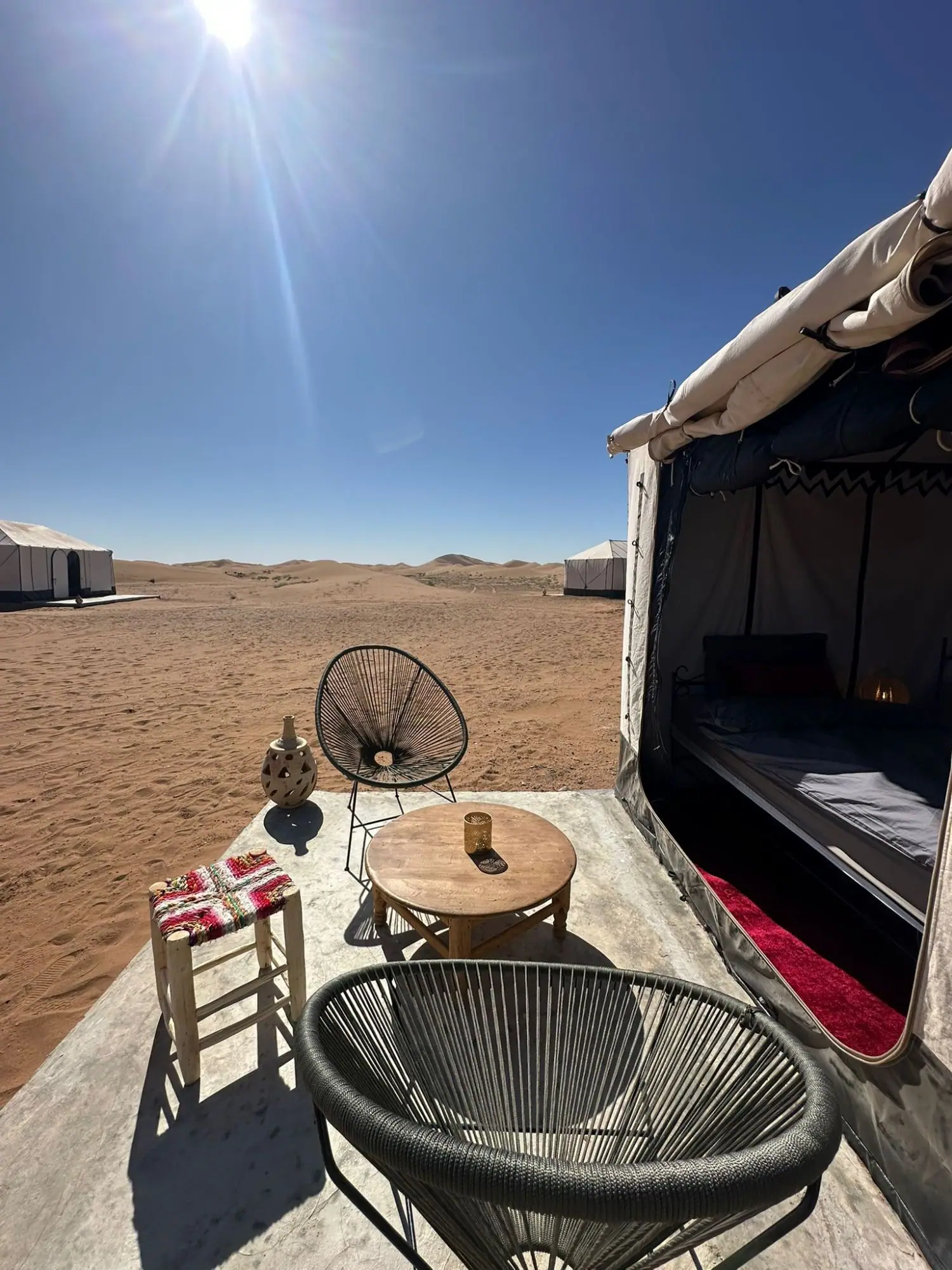
- Desert from night one: arrive in the morning, go by 4×4 in the afternoon and sleep in camp. Most of our two-day trips follow this pattern.
- Total silence: the night on the Iriki plain at Titanic Iriki (from €130) is spent under the open sky or in a traditional earthen room.
Around Christmas, New Year or Easter, book a room early and ask what it offers for the season: coolness in summer, heating or extra blankets in winter.
Two ways to plan your stay
Depending on whether you are coming from far away or have already driven all day, the easiest approach is to pick one of these rhythms.
Arrive the evening before
You reach town late in the day, eat something simple and turn in early. Next morning the 4×4 collects you at the agreed hour and you are among the dunes before the heat builds. This suits families, tired drivers and anyone hoping to catch the souk on a Thursday.
Head straight for camp
You get in during the morning, leave your car somewhere safe and set off in early afternoon. You cross Lake Iriki in low light, unroll your bedding in camp and enjoy the night sky: with no street lighting for miles, the stars come out in their thousands. You return the following day.
Either way, tell us your expected arrival time and the number of travellers, and we will fix the meeting point to match.
Before the tarmac ends: fuel, cash and signal
Small-town services change fast, so we promise only what we can deliver. Three habits to adopt before leaving:
- Fuel: fill up in Ouarzazate, Tazenakht, Zagora or Tata, then top up in Foum Zguid if a station is open. There are no pumps inside the park.
- Cash: carry dirhams. A cash machine or card payment is unlikely in villages and camps.
- Signal: it turns patchy once you leave town. Save offline maps and give someone your return date.
Water, snacks, sunscreen and personal medicines are best bought in town rather than at the edge of the dunes.
Trips that leave from town
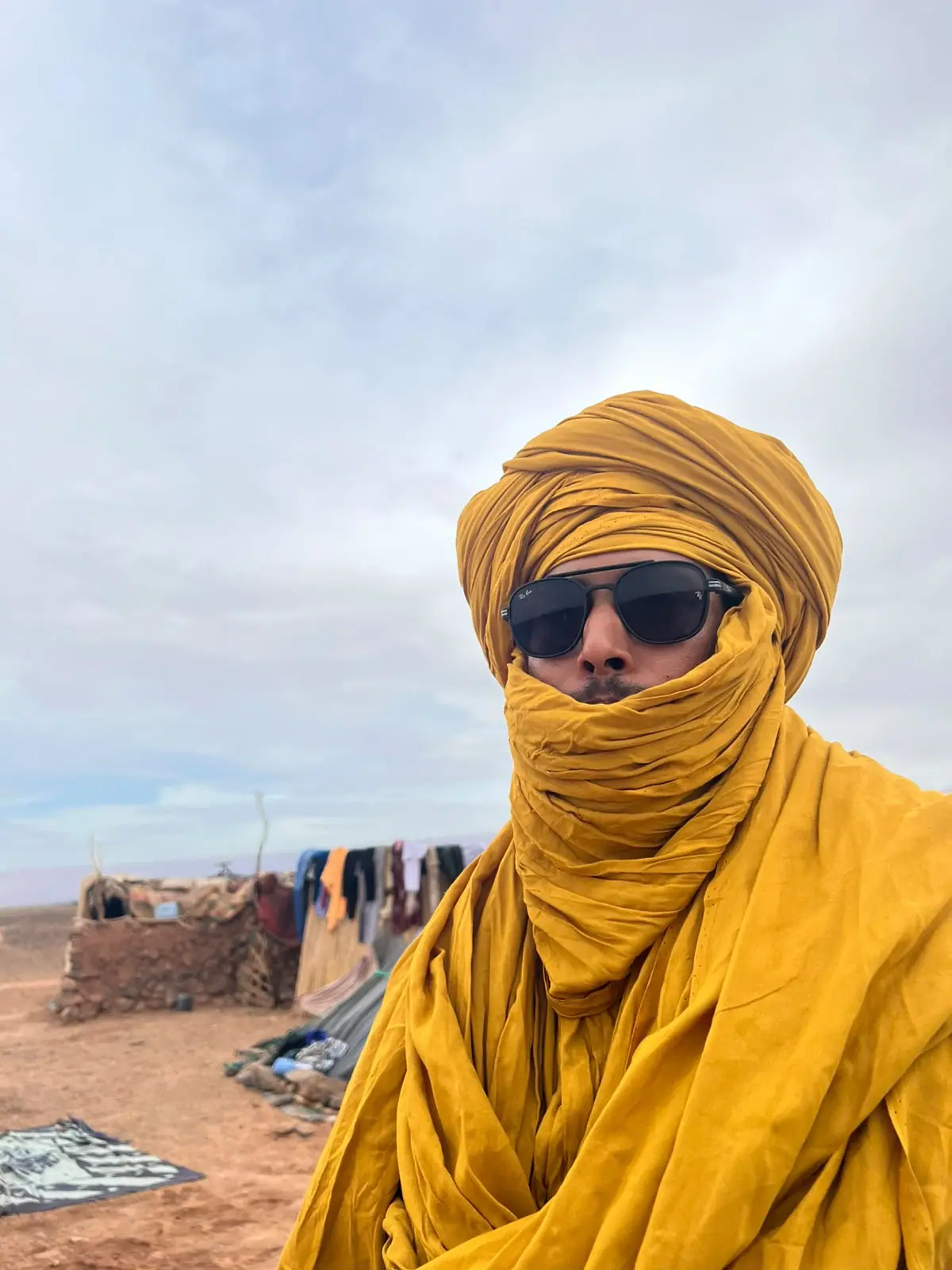
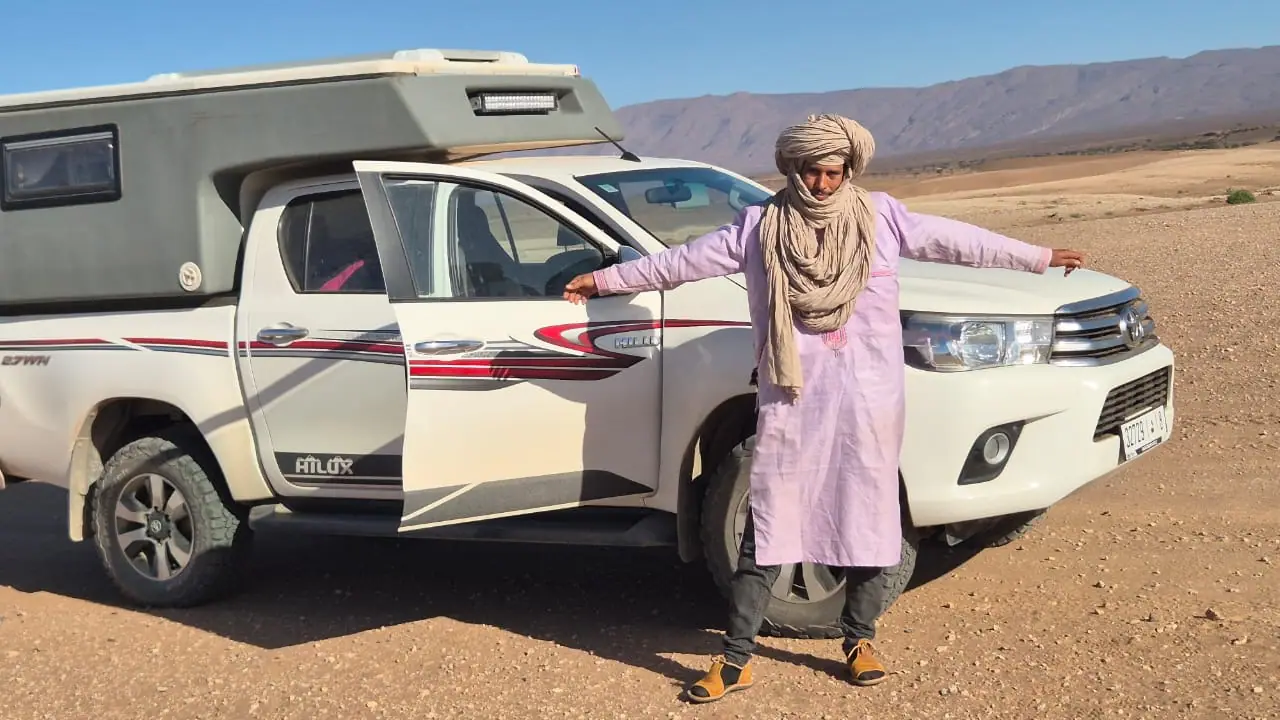
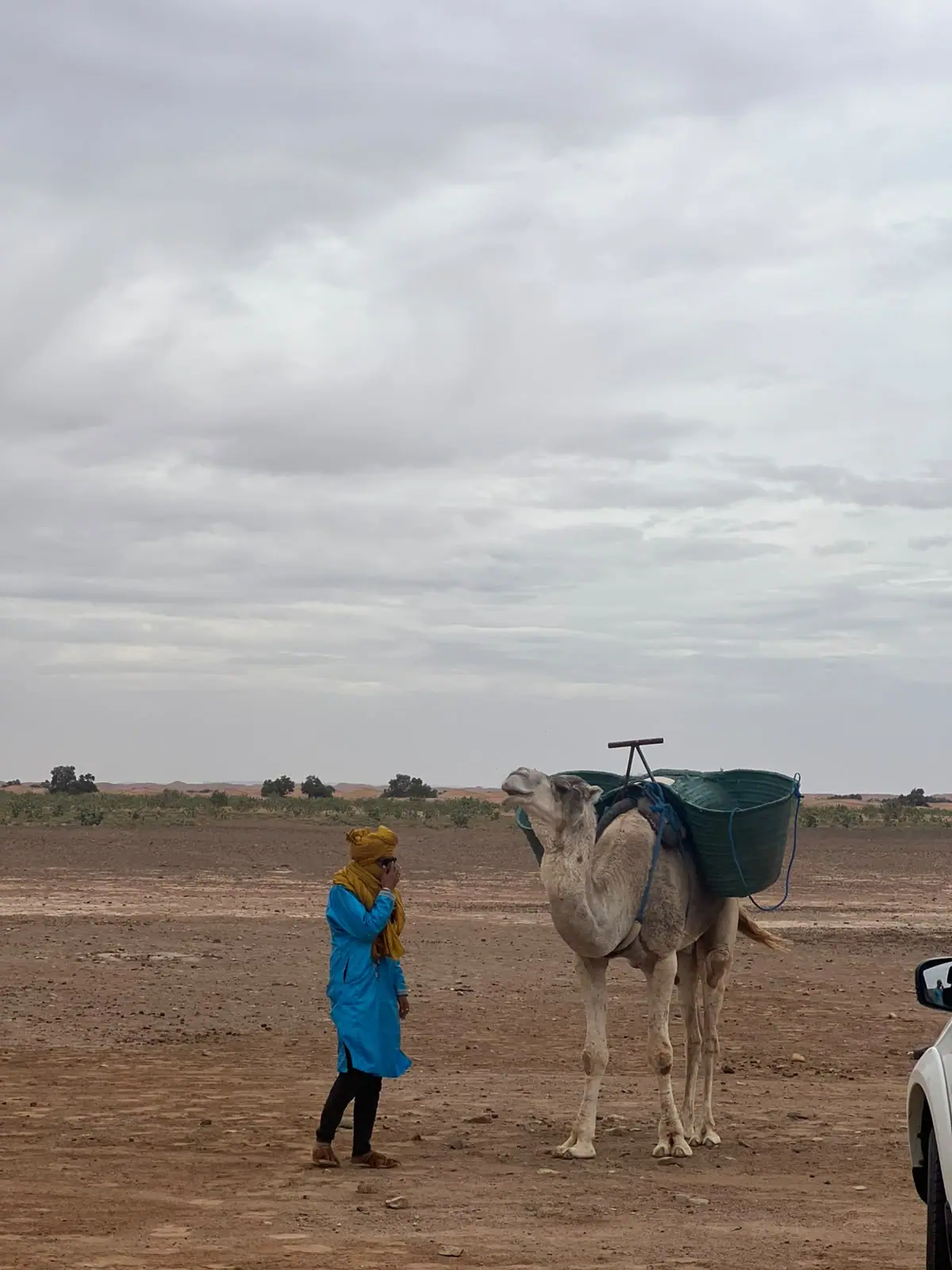
All our trips are private, by 4×4, led by Abdul, a local guide based in Foum Zguid. We agree the programme and price on WhatsApp before you book. To give you an idea:
- Lake Iriki with lunch at Titanic Iriki, from €80;
- the Tissint waterfalls in a day, from €90;
- Erg Chigaga in one day, from €100;
- a night in the Chigaga camp, from €140.
The full list, with lengths and prices, is on the page covering every Foum Zguid desert tour. If you would like to walk for several days, open the Moroccan Sahara trekking guide. Questions? Use the contact page.
Travellers’ questions
Is Foum Zguid in the Sahara?
The town is in southern Morocco, Tata Province, beneath the Jebel Bani on the N12 between Tata and Zagora. To the south it opens onto Iriki National Park, the dry bed of Lake Iriki and the Lmhazil and Chigaga dunes, so it works as the western door to a desert of stone, steppe and sand.
What is the route to Foum Zguid from Marrakech?
You cross the High Atlas by the Tizi n’Tichka pass to Ouarzazate, then drive south via Tazenakht. It is a long day, and plenty of travellers sleep in Ouarzazate. If you would rather not drive, a private tour from Marrakech, Ouarzazate, Zagora or Agadir passes through Foum Zguid before reaching the dunes.
Should I stop in Foum Zguid or go straight to the desert?
If you have time, half a day is worth it: the Thursday souk, the palm grove, the kasbah ruins and local crafts. Mostly, though, the town is a base where you sleep and stock up before heading into Iriki park, to Lmhazil or to Chigaga, with far fewer visitors than at Merzouga.
Can I count on a cash machine and a petrol pump there?
We would rather not guarantee either, because services in small towns evolve. Withdraw dirhams and fill the tank in Ouarzazate, Tazenakht, Zagora or Tata before arriving, then top up here if possible. Inside Iriki National Park and along the tracks there is neither fuel nor cash.
Is a 4×4 essential for Lake Iriki and Chigaga?
Yes. The tarmac ends at Foum Zguid; after that the tracks are unmarked and mix soft sand with stony stretches. Without a 4×4 and local knowledge you risk getting stuck or losing your way. Every one of our trips uses a private 4×4 with a local guide.
How many nights should I plan in the area?
One night in town covers the market and the palm grove. Add at least one night in camp for sunset, the starry sky and sunrise over the dunes. With three days you can combine Lake Iriki, a night at Titanic Iriki and a night at Chigaga, or set out on a short trek.
Which season should I choose?
Roughly October to April. In summer, daytime heat often passes 40 °C, which makes the tracks tiring. Winter days are mild, yet nights in camp can approach freezing, so bring warm layers. A sandstorm can blow up in spring, and the guide then adjusts the plan.