Updated: 11 November 2026
Chigaga, at the end of the Foum Zguid desert
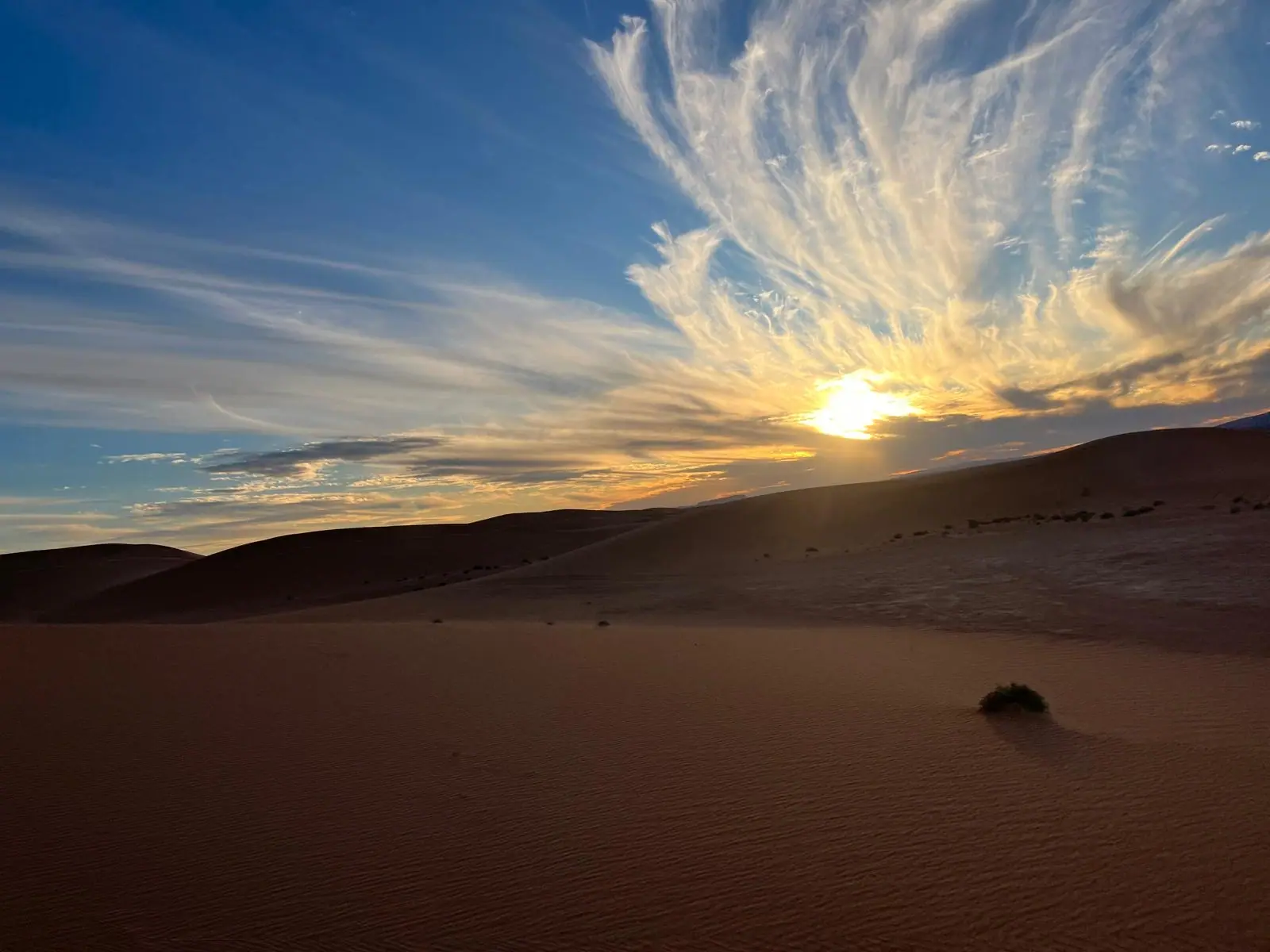
An erg is a mass of wind-sculpted sand, the opposite of the hamada, the stony plateau you cross on the way. Chigaga (also written Chegaga) is the largest in the country: around 35–40 km long and roughly 15 km wide. Many crests stand at 60–80 m, and a few climb higher.
It belongs to the Drâa basin and lies about 55 km from M’Hamid El Ghizlane, on its western side. From the opposite direction, Foum Zguid, a small oasis town backed by the Jebel Bani on the N12 between Tata and Zagora, is the natural starting point. Between the two stretches the bed of Lake Iriki, in the middle of Iriki (Iriqui) National Park.
At the foot of the dunes you will find no village and no road, only a few widely spaced camps and a deep silence. That remoteness is the whole appeal if Merzouga feels too busy, and it is why a local driver in a proper off-road vehicle is not optional.
Reaching Chigaga: from the west via Foum Zguid, from the east via M’Hamid
There are two ways in, and both end on a track:
- From Foum Zguid: you cross the Iriki plain, a lakebed that stays dry nearly all year. Plan on two and a half to three hours by 4×4, longer if you stop often. Tarmac gets you to Foum Zguid from Ouarzazate (roughly 150 km through Tazenakht), from Tata or Zagora on the N12, or from Agadir via Taroudant and Taliouine.
- From M’Hamid El Ghizlane: the traditional route from the Drâa valley, with about 55 km of track to the edge of the massif.
Entering from the west has one advantage: crossing Iriki is already part of the journey, and you can sketch a loop rather than an out-and-back. Our circuits from Zagora and Ouarzazate reach the dunes through M’Hamid and return via Iriki and Foum Zguid. The track and its stages are described on Chigaga from Foum Zguid by 4×4. A standard rental car goes no further than Foum Zguid or M’Hamid.
Chigaga, Merzouga or Erg Lmhazil: three ways to sleep in the sand
Merzouga, far to the east near Erfoud, is the benchmark: the dune desert most travellers visit. Chigaga is more distant and far broader, though its highest crests generally stay below those of Erg Chebbi. Erg Lmhazil (El Mhazil), in the Foum Zguid desert, offers smallness and calm instead.
| Compare | Chigaga | Merzouga / Erg Chebbi | Erg Lmhazil |
|---|---|---|---|
| Where | South, between M’Hamid and Foum Zguid | Eastern Morocco, at the edge of Merzouga village (some 60 km from Erfoud) | In the Foum Zguid desert, past Iriki |
| Getting there | Track only, 4×4; about 55 km from M’Hamid | Tarmac as far as the village | 4×4 from Foum Zguid across the Iriki plain |
| Extent | 35–40 km by about 15 | About 28 km north to south, 5–7 km wide | A much smaller dune field |
| Height | Mostly 60–80 m, sometimes more | Up to about 150 m in places | Dunes that are pleasant to walk |
| Feel | Few visitors, camps well apart | The busiest dunes in the country | Very peaceful |
| Pick it if… | You want wide open space and the Iriki crossing | You want an easy road and plenty of hotels | You want silence and a gentle walk |
Put simply: Merzouga for convenience, Chigaga for scale, and for dunes that feel almost private, Erg Lmhazil near Foum Zguid. Our overview of Morocco’s deserts widens the comparison.
A night in camp: firelight, silence and a sky full of stars
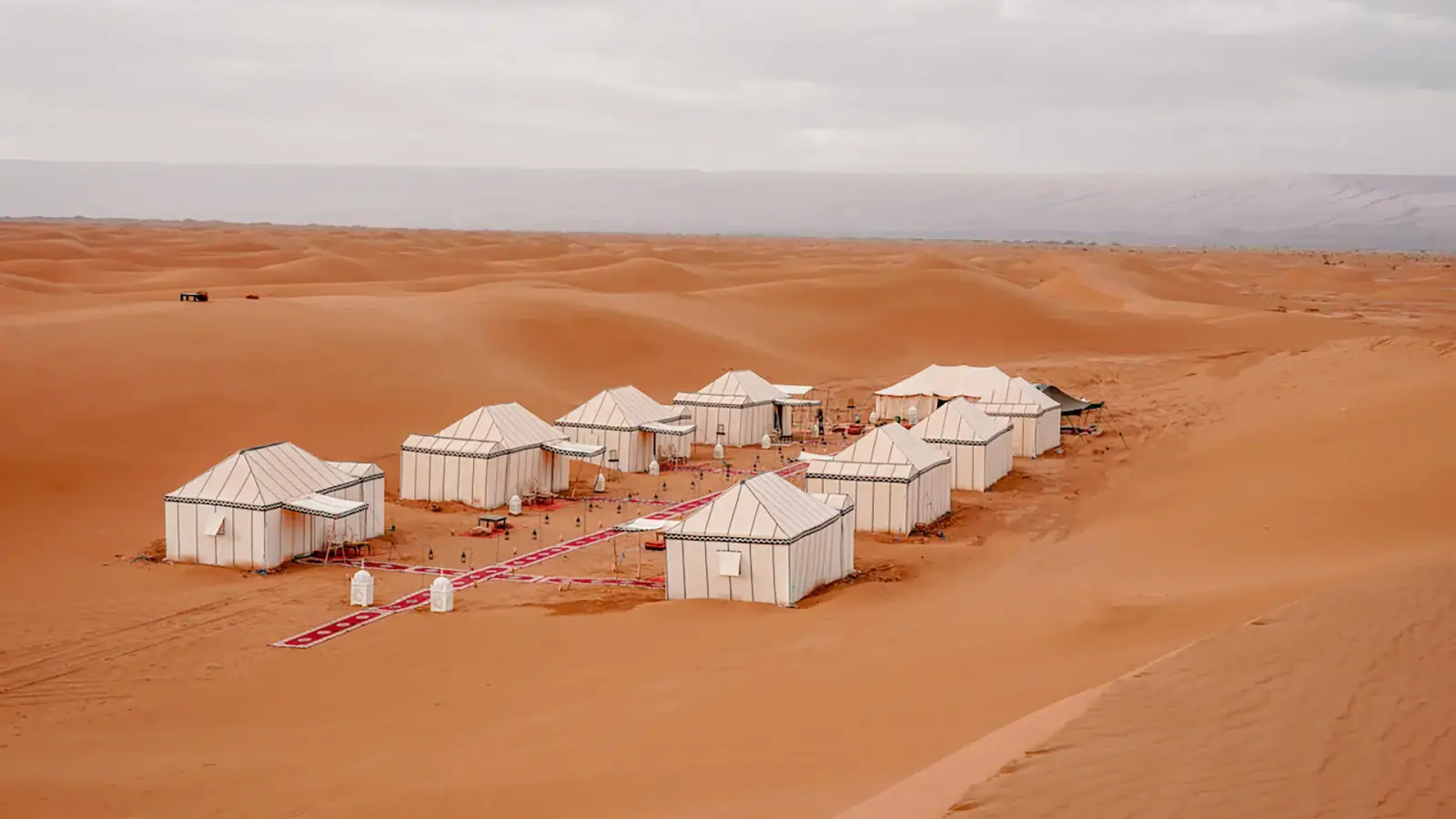
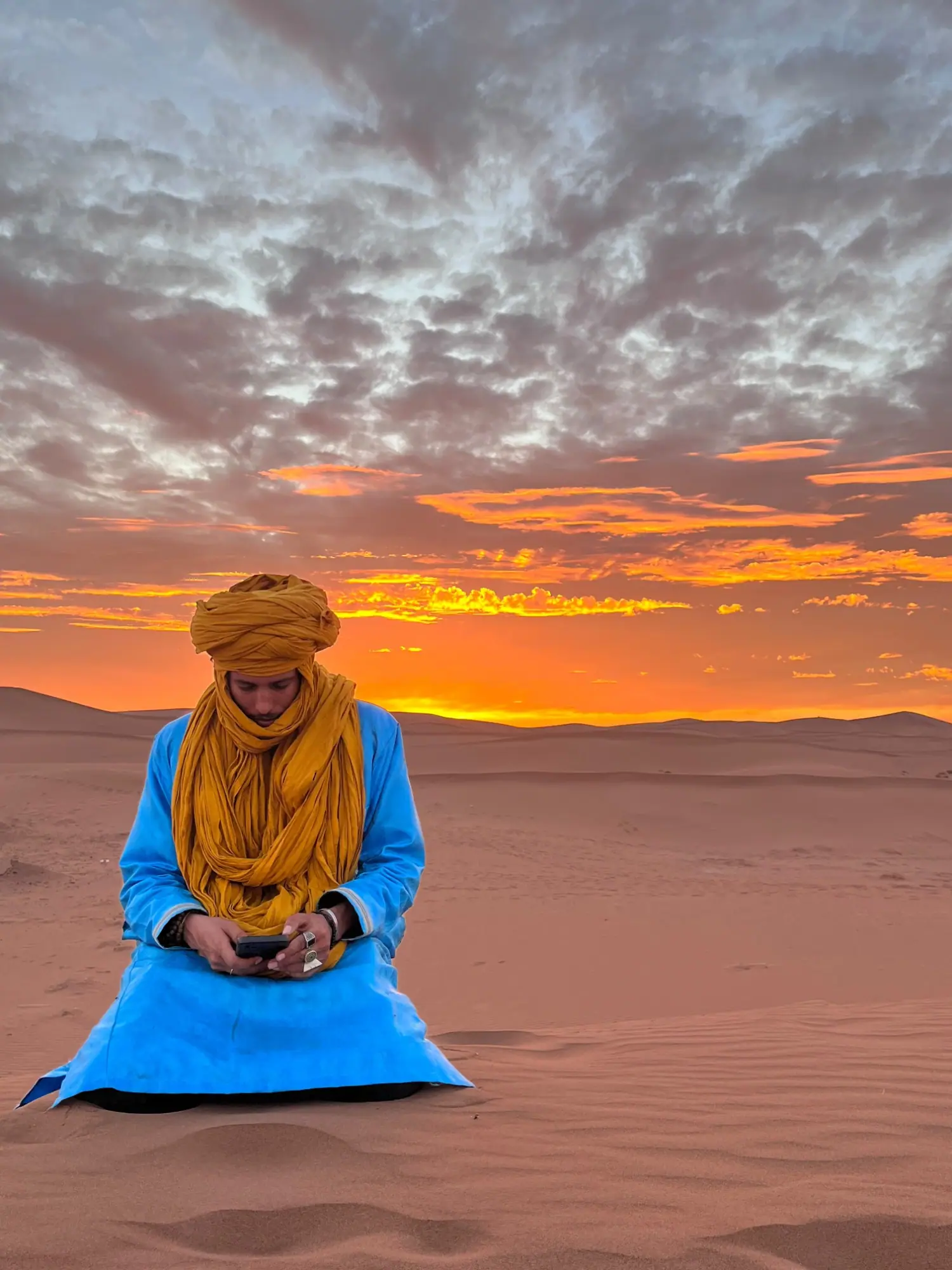
Sleeping at Chigaga is mostly about two moments: the sun sinking behind the crests, then the night, so far from any light that the Milky Way shows. Operators’ camps fall roughly into three families:
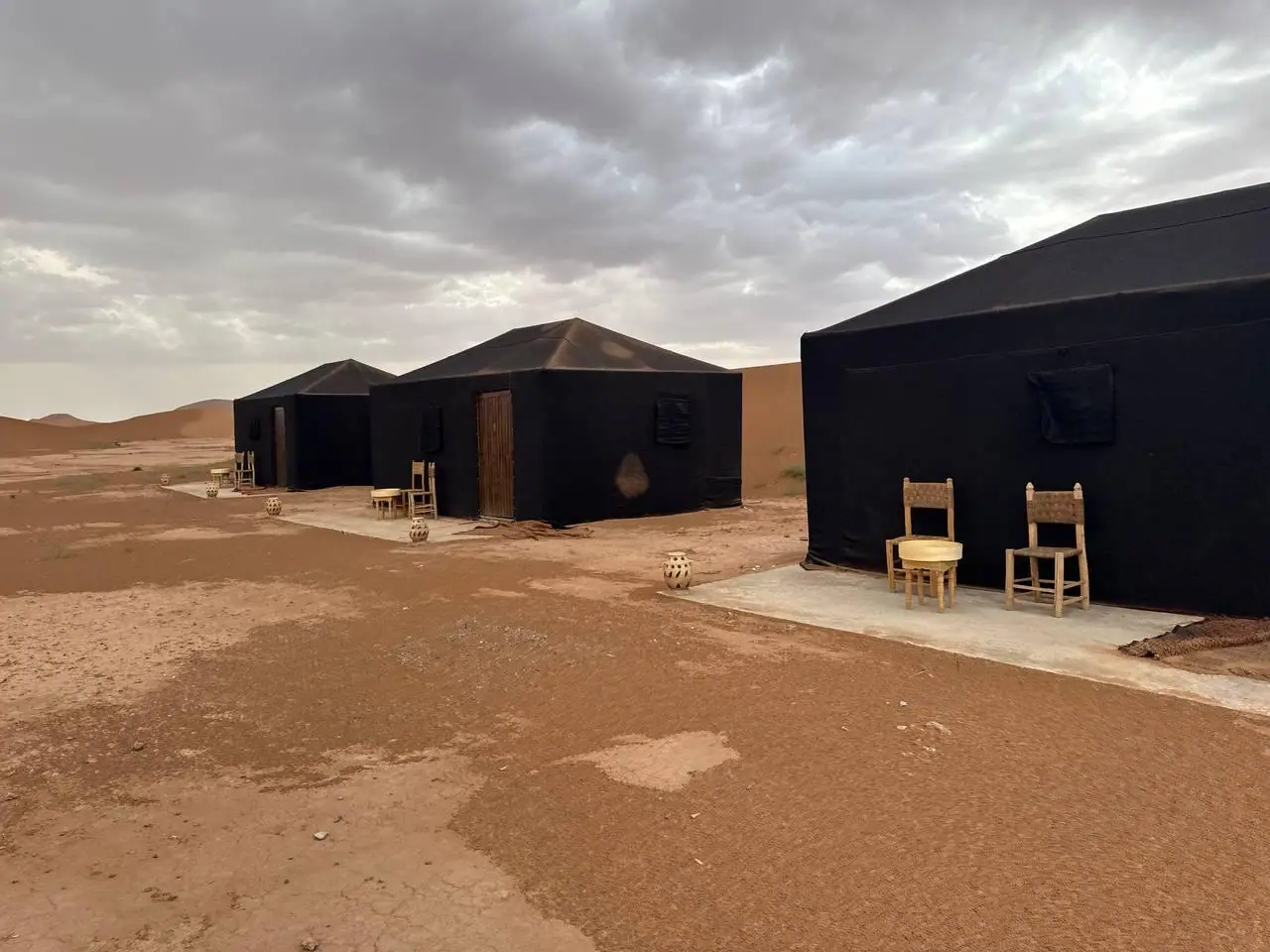
- Nomad or standard camp: tents of canvas or woven cloth, with mattresses or cots and blankets; meals taken inside or by the embers; shared washing facilities are common.
- Comfort camp, sometimes called “luxury”: roomier tents, proper beds and, in some cases, a private bathroom. It costs more and should be requested when you book.
- Mobile camp: on a trek the tent goes up somewhere new each evening, or you sleep in the open.
On our overnight trips you sleep in a nomad tent after a dinner cooked on a wood fire; treks use mobile camps. Whoever you travel with, ask the right questions: bedding, toilets, hot water, charging points, extra blankets in winter. With us, programme and accommodation are agreed with you before departure.
What to do around Chigaga
- Watch the sun set, then rise over the crests, the core of any night in the desert.
- Ride a camel: included on trips with a night, offered as an extra (about an hour) on the day trip.
- Climb a big dune on foot, which is slower than it looks in soft sand.
- Enjoy the evening: dinner, music by the fire, a sky thick with stars.
- Walk in the early morning, or for days on a trek with a camel caravan that carries the luggage.
- Stop on the way, as the programme allows: the lakebed, fossils, the Titanic Iriki guesthouse, a nomad school, Zaouiat Sidi Abdenabi.
How long to allow? A day is enough to see the dunes but you leave before dusk. One night gives you the evening and the dawn in the sand. With two nights, the programme adds the Titanic Iriki and a nomad school.
When to go: autumn to spring
The best window runs from October to April. In summer the heat is harsh; in winter the nights are bitter.
| Months | Daytime feel | Night | Our view |
|---|---|---|---|
| October, November | Warm to mild | Cool | Excellent time |
| December to February | Mild | Cold, sometimes near 0 °C | Lovely, if you pack warm layers |
| March, April | Mild to warm | Cool | Good; wind can raise sand in spring |
| May to September | Very hot, often above 40 °C in summer | Warm | Poor for walking; short outings, early starts |
When exceptional rain falls, Lake Iriki can hold some water and certain tracks turn soft: the driver then changes the route.
In the bag for the night
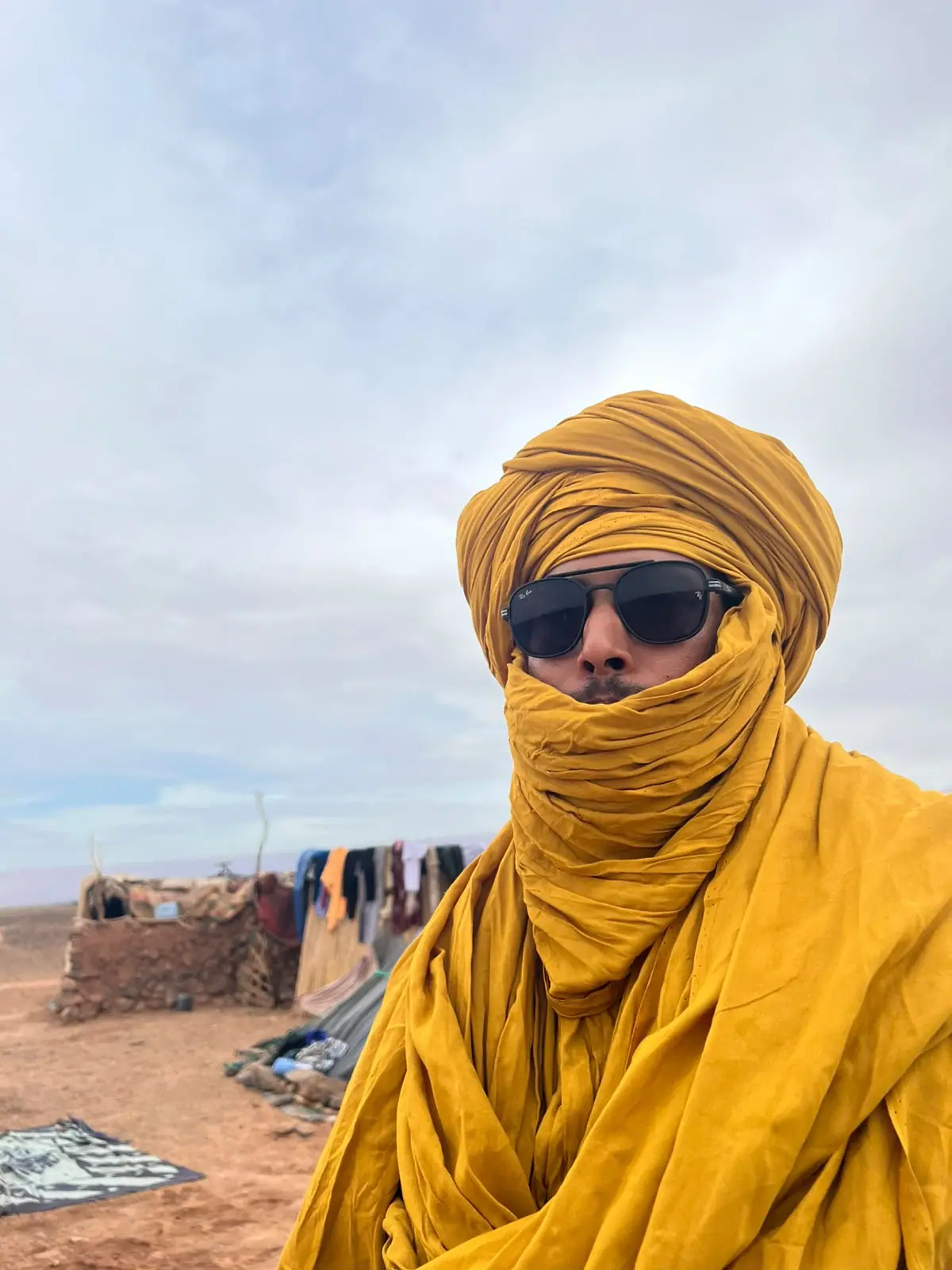
- A scarf (shesh), sunglasses, sun cream and a cap.
- A fleece from autumn onwards; in winter, a woolly hat and several layers for the evening.
- Light shoes that close over the toes for the track; sandals or bare feet once on sand.
- A head torch plus a power bank, since camps have little electricity or none.
- Your medication, a little cash and a bag to carry your rubbish home.
Be careful: never head into the sand on your own
Chigaga is isolated, which is precisely why it is not a place to drive alone. A vehicle gets stuck fast in soft sand, tracks cross each other on the plain and the wind rubs out landmarks.
- Travel with a local driver-guide and a well-maintained 4×4.
- Carry more water than you think necessary and leave your route with someone.
- Do not count on your phone: coverage is patchy in the desert.
- After a shower, let the guide pick the way, as the bed of Lake Iriki can be waterlogged.
- Take your rubbish with you and ask permission before photographing people.
Our trips to Chigaga and their starting prices
All trips are private; the figures are “from” prices per person, confirmed before you book. The day-by-day detail is on the page about the Foum Zguid to Chigaga route.
- One-day excursion to Chigaga: 1 day, from Foum Zguid, from €100.
- Night in a camp at Erg Chigaga: 2 days / 1 night, Foum Zguid, from €140.
- Foum Zguid to Chigaga, with a night at the Titanic Iriki: 3 days / 2 nights, from €260.
- Zagora – Chigaga – Foum Zguid loop: 2 days / 1 night, from Zagora, from €225.
- Ouarzazate to Chigaga via Foum Zguid: 2 days / 1 night, from Ouarzazate, from €290.
- Agadir to Chigaga via Taroudant: 3 days / 2 nights, from €410.
- On foot: the oasis-to-Chigaga trek lasts 6 days / 5 nights from Foum Zguid (from €640), and the Agadir to Chigaga trek 7 days / 6 nights from Agadir (from €740).
Not much time? Take the day trip. Dreaming of a first night under the stars? The 2 days / 1 night. Curious about the Titanic Iriki and a nomad school as well? The 3 days / 2 nights. If you are based in Zagora, Ouarzazate or Agadir, our desert circuits across Morocco include transport. Message us on WhatsApp at +212 649 598 615 or through the contact page, or look through the full catalogue.
Travellers’ questions
How long is the drive to Chigaga?
From Foum Zguid, expect between two and a half and three hours of 4×4 track over the Iriki plain, depending on ground conditions and your breaks. From M’Hamid El Ghizlane, roughly 55 km of track lead to the dunes. If you start in Ouarzazate, add about 150 km of tarmac to reach Foum Zguid first.
Chigaga or Merzouga: which desert should I choose?
It depends on your priorities. Merzouga can be reached by car, is full of places to stay and has dunes of up to roughly 150 m, but it is the busiest site in the country. Chigaga, broader and more remote, can only be reached by 4×4. Choose it if you want solitude more than convenience.
Can I get to Chigaga without a 4×4?
No. No tarmac road reaches the dunes, whether you set out from Foum Zguid or M’Hamid; the last leg is track and sand, and a hire car stops in town. Even with a 4×4 it is wise to avoid going without a local driver, since getting stuck and finding your bearings both take experience.
What is the best season for Chigaga?
Between October and April. In autumn and spring, afternoons are comfortable and evenings cool; midwinter keeps the afternoons mild but nights can fall to around 0 °C. Spring may bring sand in the wind. Summer, May to September, frequently tops 40 °C, which calls for a short outing starting at dawn.
How much does a night in camp at Chigaga cost?
From Foum Zguid, our 2 days / 1 night trip in a nomad tent starts from €140 per person, and the 3 days / 2 nights trip with a night at the Titanic Iriki from €260. The Zagora circuit starts from €225, the Ouarzazate one from €290 and the 3-day Agadir trip from €410. The final price is confirmed before booking.
Is it possible to see Chigaga in a single day?
Yes, starting from Foum Zguid. For €100 per person and up, the outing runs through Iriki National Park with lunch in the village of Zaouiat Sidi Abdenabi, tea at the dunes and a dune to climb, before the return over the lakebed. Expect a long day that ends before sunset; sleeping out is gentler.
Do Chigaga and Chegaga refer to the same place?
Yes. The name is transcribed two ways, and both appear on maps, in guidebooks and on tour operators’ pages. Either way it means the same giant dune field, lying beyond Lake Iriki when you come from Foum Zguid, and about 55 km out of M’Hamid El Ghizlane.