Updated: 11 November 2026
Walking the Foum Zguid desert: what a trek means here
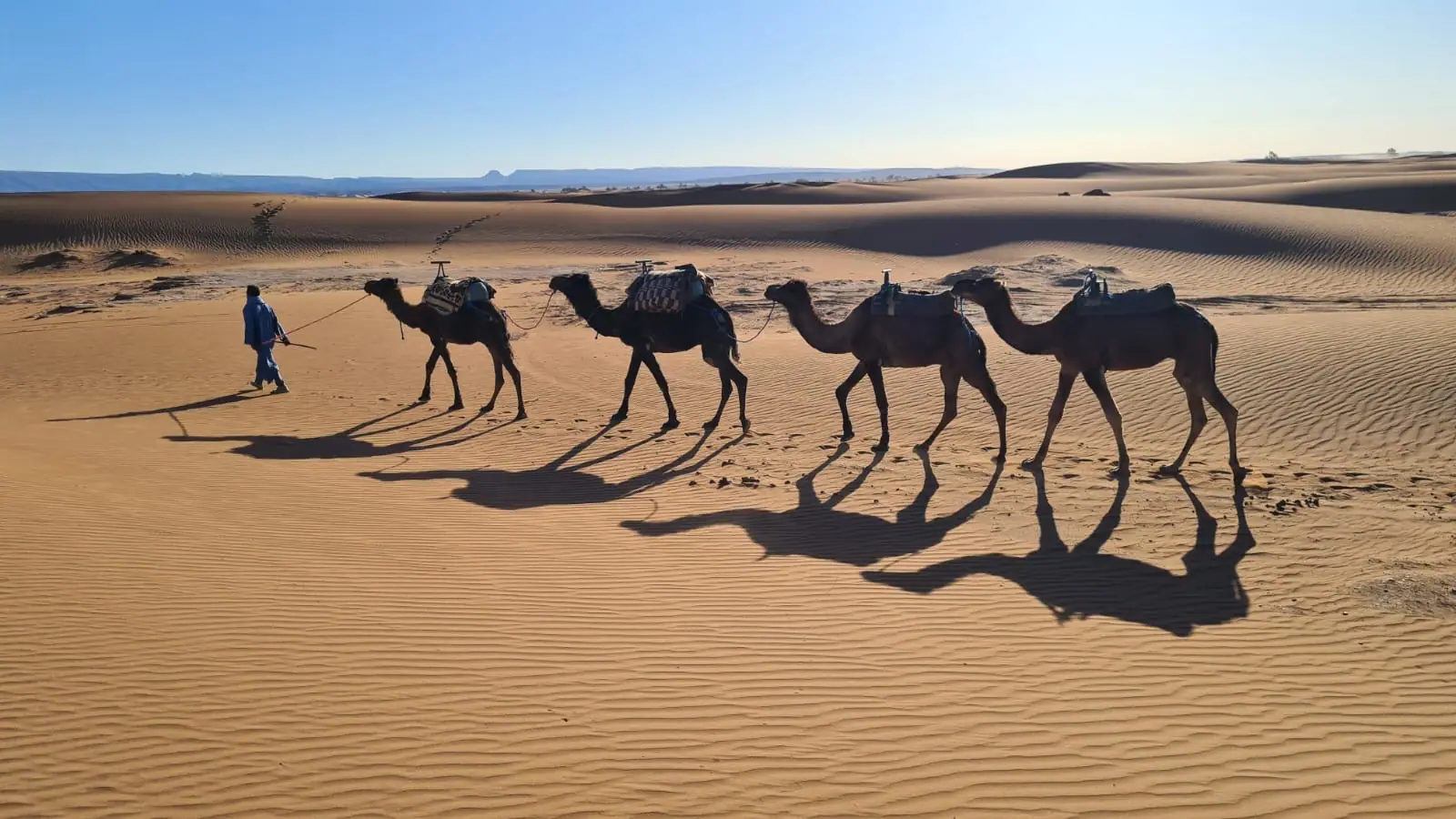
In our desert, trekking follows a simple principle: you walk from one camp to the next, led by a guide, while a camel caravan hauls the tents, kitchen, water and luggage. When the day ends, camp goes up at the foot of a dune, dinner cooks over a fire and you sleep in a tent or out in the open. Silence is complete, and with no light pollution the sky is crowded with stars.
The usual starting point is Foum Zguid, on the western edge of Iriki (Iriqui) National Park. Depending on length, routes link quiet dune fields (Erg El Mhazil, Elhaj Ahmed, El Ghoule), an oasis at El Grisim and, for the longer ones, the high dunes of Erg Chigaga (also spelt Chegaga), Morocco’s largest erg. A 4x4 normally covers the journey in and out.
Every trek is private: your group, your dates, and a programme agreed with you before booking.
Five treks, five lengths: which one fits you?
| Trek | Price from | Length | Best for | Walking hours quoted |
|---|---|---|---|---|
| Desert hike and nomad school visit | €250 | 3 days, 2 nights | A first try, starting in Foum Zguid | roughly 4 h on day 2 and 2 h on day 3 |
| Trek in Iriki National Park | €300 | 4 days, 3 nights | A calm immersion, starting in Foum Zguid | a few hours a day, to suit the group |
| Trek in the heart of the dunes | €640 | 5 days, 4 nights | The dune fields and the oasis, from Marrakech or Agadir | a few hours a day, to suit the group |
| Oasis to Erg Chigaga trek | €640 | 6 days, 5 nights | Reaching Chigaga on foot; transfer from Agadir or Marrakech possible | roughly 3 h on day 3 and 2–3 h on day 4 |
| Agadir to Chigaga trekking | €740 | 7 days, 6 nights | The most complete crossing, from Agadir | a few hours a day, to suit the group |
- To ease into walking: the 3-day nomad school hike or the 4-day Iriki park trek.
- To sink into the dunes: the 5-day trek.
- To reach Chigaga under your own steam: the 6- or 7-day options.
What walkers actually do, stage by stage
Three days with the nomad school
On the first afternoon a 4x4 leaves Foum Zguid and crosses Iriki to the camp at Erg El Mhazil. Next day about four hours’ walking takes the caravan and its walkers to Erg El Ghoule, where you sleep outdoors. On day three, two hours of trail lead to the nomad school; the visit goes ahead if the families are able to welcome you. A 4x4 then returns via Lake Iriki. From €250.
Four days in Iriki National Park
You set off at 2 pm, cross the lake bed and watch the sun go down over Erg El Mhazil. Day two is a gentle walk with the camels to a new camp. On day three you reach a nomad oasis for tea, then sleep in an earth-built guesthouse at Zouat Sidi Abdnabi. On the fourth day a 4x4 brings you back, arriving around late morning. From €300.
Five days in the heart of the dunes
Day one is a road day from Marrakech (over the Tizi n’Tichka) or from Agadir, passing Tazenakht and Foum Zguid to a camp at Erg El Mhazil. Two walking stages follow, to Erg Elhaj Ahmed and then Erg El Ghoule, with an evening by the fire. On day four you reach El Grisim oasis, taste bread baked in the sand and tea, and sleep beneath palms. On day five a 4x4 takes you back through Iriki and the transfer is waiting. From €640.
Six days from the oasis to Chigaga
After the transfer from Agadir or Marrakech, the first night is in a riad in Foum Zguid. A 4x4 then crosses Lake Iriki to El Grisim, where you camp. About three hours’ trekking leads to the Erg Chigaga dunes; the following day two to three hours of walking take you further into the sand, away from everything. The fifth day belongs to Erg El Ghoule, with tea and sunset. On the sixth morning the 4x4 delivers you to Foum Zguid around 11 am. From €640.
Seven days from Agadir
The published programme has six stages: the road from Agadir to Erg El Mhazil through Taroudant and Taliouine, the walk to Elhaj Ahmed, then El Ghoule, El Grisim oasis and the tamarisk dunes, and finally Erg Chigaga, where the great dune is climbed as daylight fades. We settle with you, at booking, how the last day closes. From €740.
Do you need to be an athlete to walk the dunes?
No mountain experience is required, yet this is no stroll. Loose sand wears you out faster than a firm track, dune climbs are short and steep, and wind or heat add to the effort. From one day to the next, tiredness builds.
- Suitable profile: you can walk two to four hours without difficulty.
- Pace: a few hours’ walking a day, set by the group, with shaded rests when the sun is strong. Where a programme quotes hours, they run from two to about four.
- Children and older walkers: realistic on the shorter formats; talk to us before booking.
- Health: mention any back, knee or heart concern, since camp is far from medical help.
The camel caravan and the ground underfoot
On these treks camels are, above all, pack animals: tents, kitchen, water, luggage. The cameleer leads them, loads them in the morning and takes them to the next camp, so you walk light with a small bag. Want to ride one for part of a stage? Say so when you book.
The surface changes almost every stage:
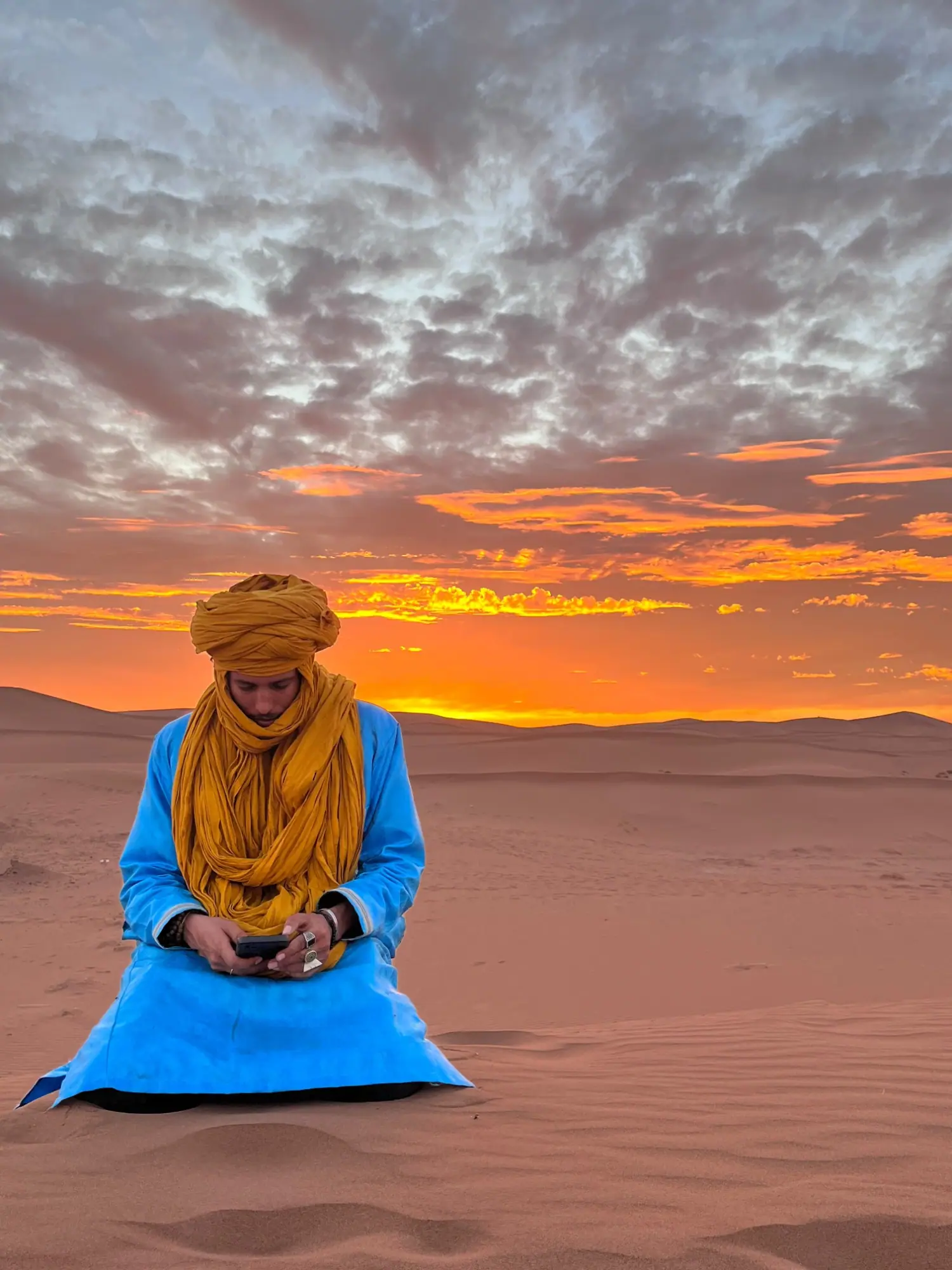
- Dunes: fine sand first at El Mhazil and El Ghoule, then at Chigaga, where most rise between 60 and 80 m and a few higher.
- Plains of gravel and the huge dried-out bed of Lake Iriki.
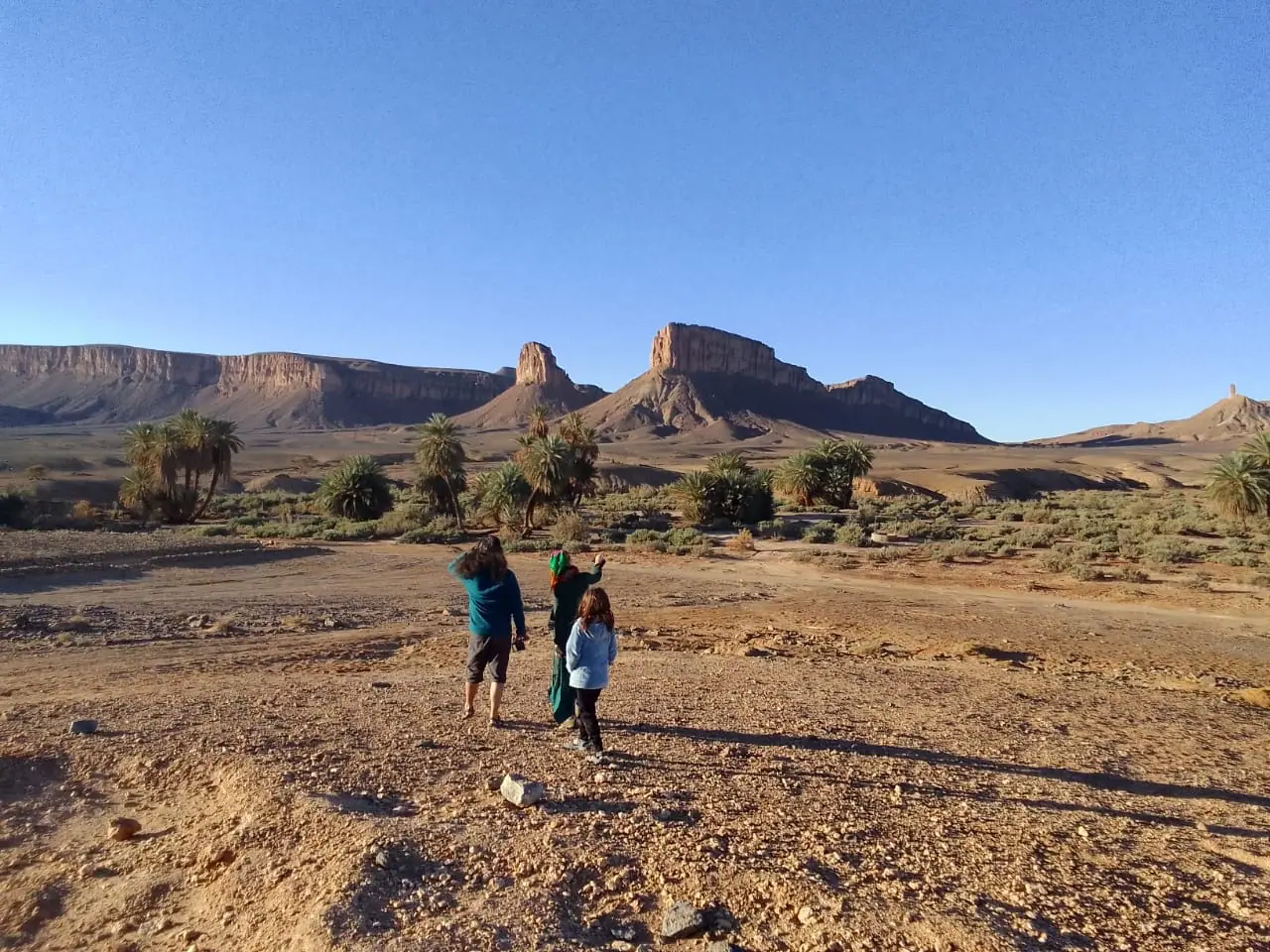
- Steppe scattered with acacias and tamarisk thickets, where the ground is firmer.
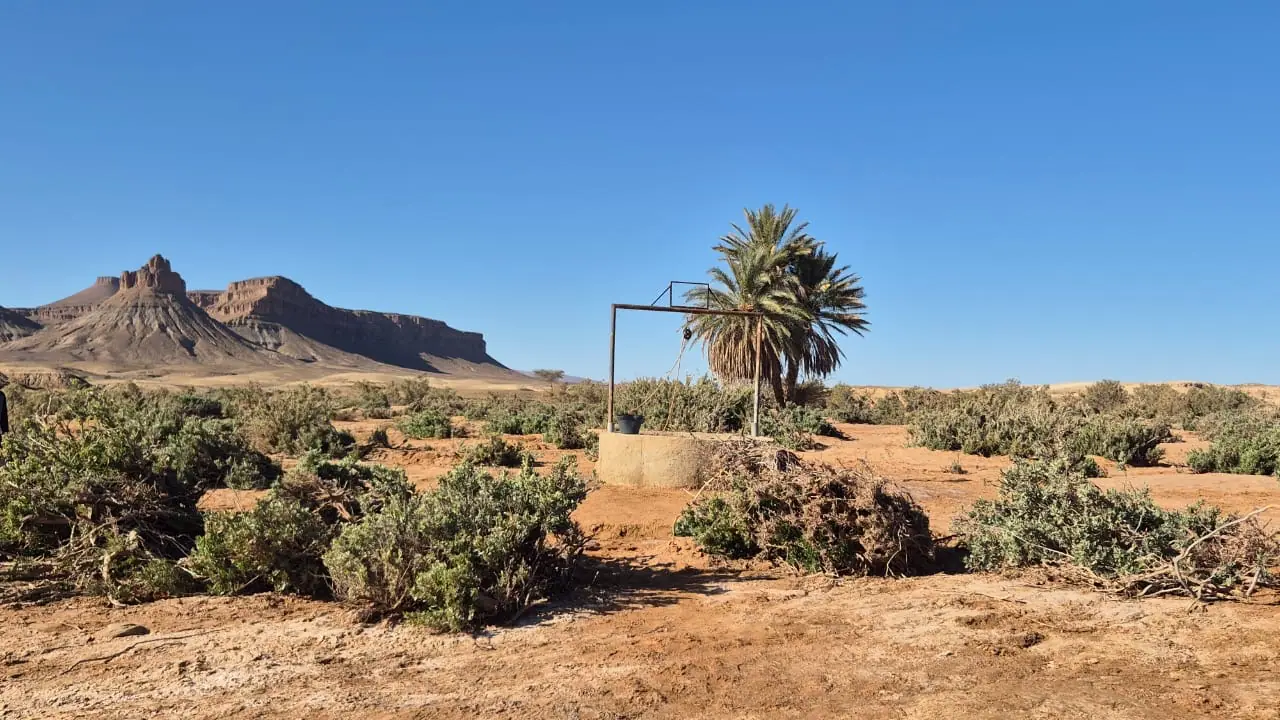
- Oases, such as El Grisim, with palms and water.
Sleeping at camp: stars, meals, water and washing
Nights are spent in nomad-style camps: a tent, or just a mat under the sky when weather and preference allow. A few itineraries add one night in a riad or a mud-built house. Food is prepared at camp: a morning meal, a lunch break in the shade, supper by the fire, then mint tea.
- Water: it travels with the caravan. Carry a flask holding 1.5 litres or more, and ask how much is planned for each person every day.
- Washing: comfort stays basic, with no shower on walking days. Biodegradable wipes and hand sanitiser help.
- Rubbish: keep it with you so that it leaves with the equipment.
- Meals: tell us about an allergy or a vegetarian diet before departure.
What to put in your bag
- Light, breathable walking shoes you have already worn, and low gaiters against sand.
- Wide-brimmed hat, sunglasses, sun cream and lip balm.
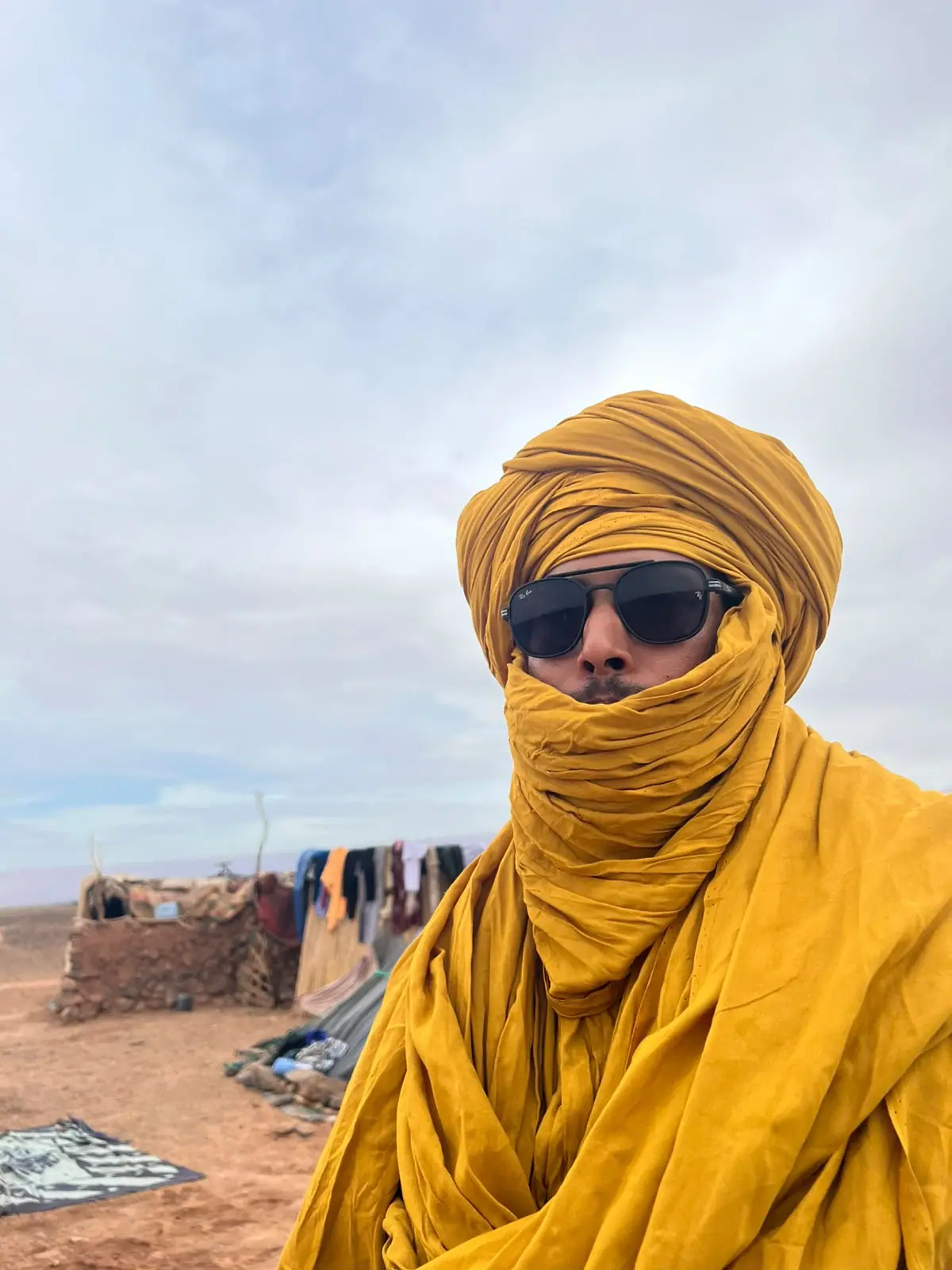
- A cheche or scarf, essential against sun, wind and blowing sand.
- By day, light long sleeves; by evening, a fleece and a down jacket.
- A warm sleeping bag in winter: ask what is supplied.
- A head torch, a power bank and your own small first-aid pouch.
- A soft bag for the caravan and, for daily use, a small rucksack (20 to 30 litres).
When to go, safety and booking
Trekking is best from October to April: days suit walking, although winter nights can approach freezing and spring winds may whip up sand. From May to September temperatures regularly pass 40 °C, and we advise against multi-day walks then.
There are no fixed group departures: each trek is organised privately, on your dates and at the pace you choose. On safety, listen to your guide, drink often, stay within reach of camp and take travel insurance with medical assistance. Clubs, friends travelling together or charity challenge teams are welcome to ask about a tailored route.
Prefer to stay in a 4x4? Look at our Moroccan desert excursions, our circuits from the big cities or the one- to three-day trips in the Foum Zguid desert. For a custom plan, use the contact page or send a WhatsApp message to +212 649 598 615.
Travellers’ questions
What is the length of a desert trek in Morocco?
Between three and seven days with us: 3 for the nomad school hike, 4 for Iriki National Park, 5 for the trek in the heart of the dunes, 6 for the oasis to Erg Chigaga trek and 7 for the crossing from Agadir. The drive in and out is by 4x4.
What level of fitness does the trek need?
Good general fitness is enough; you need not be a high-level athlete. You walk a few hours a day at the group’s pace, and where a programme gives a figure it is two to about four hours. Loose sand and heat tire you faster than flat ground, so being used to walking helps.
How much does a camel-supported desert walk cost?
From €250 per person for 3 days with the nomad school, from €300 for 4 days in Iriki park, from €640 for the 5- and 6-day treks and from €740 for 7 days from Agadir. The programme and final price are confirmed before you book anything.
What season is right for walking in the Moroccan Sahara?
October to April. Days suit walking, but winter nights can be cold, close to freezing, and sand may blow in spring. Between May and September temperatures often exceed 40 °C, which turns a multi-day trek into a gruelling and risky undertaking.
Can I ride a camel during the trek?
The camels mainly carry kit, water and bags, guided by the cameleer, and you carry only a small bag. Fancy riding for a stretch, perhaps because you are tired? Mention it when you book and we will organise it.
Where and how do you sleep on the trek?
At a nomad-style camp, in a tent or in the open depending on the weather. On some programmes there is also a night in a riad at Foum Zguid, or in a mud-built guesthouse at Zouat Sidi Abdnabi. Comfort is simple: meals cooked at camp and no shower on walking days.
Which treks reach Erg Chigaga?
Only two: the oasis trek (6 days, from €640) and the Agadir trek (7 days, from €740), which ends by climbing the great dune as the sun sets. Shorter options remain among the calmer dunes at El Mhazil and El Ghoule.