Updated: 11 November 2026
A garden made out of stone, sand and patience
Put aside the picture of a puddle with three palm trees. Across southern Morocco an oasis is, above all, a field: families over many generations brought in water from a wadi, a spring or an aquifer and shaped the land around it. Take that effort away and only gravel remains.
A classic palm grove reads in three storeys:
- the roof, made of date palms that give fruit and shade;
- the middle storey, home to fruit trees such as pomegranate;
- the sheltered floor, where vegetables, cereals and fodder grow.
The arrangement keeps the soil cool and damp and squeezes a surprising harvest from very little ground. Beside the gardens stand ksour, fortified villages of earth, and now and then a kasbah. Walking through a Moroccan oasis therefore means stepping into people’s fields and lanes, which is a long way from a postcard backdrop.
The Foum Zguid palm grove: a first walk before the dunes
Foum Zguid is an oasis itself, backed by the Jebel Bani, the long rocky ridge crossing Tata Province. Before you drive towards Chigaga, an hour on foot beneath the fronds, along shaded tracks between gardens, explains much of what you will see later.
Two other stops round out the Jebel Bani area:
- Allougoum, some 25 km to the north, a neighbouring oasis whose earthen ksar is being restored (mosque, dwellings, vaulted passages);
- Zaouiat Sidi Abdenabi, further south, a traditional village under the ridge with a marabout’s tomb. Some of our programmes lunch there in a pisé house.
For the town, its Thursday souk and its services, see our practical guide to staying in Foum Zguid.
Tissint: salty waterfalls inside a palm grove
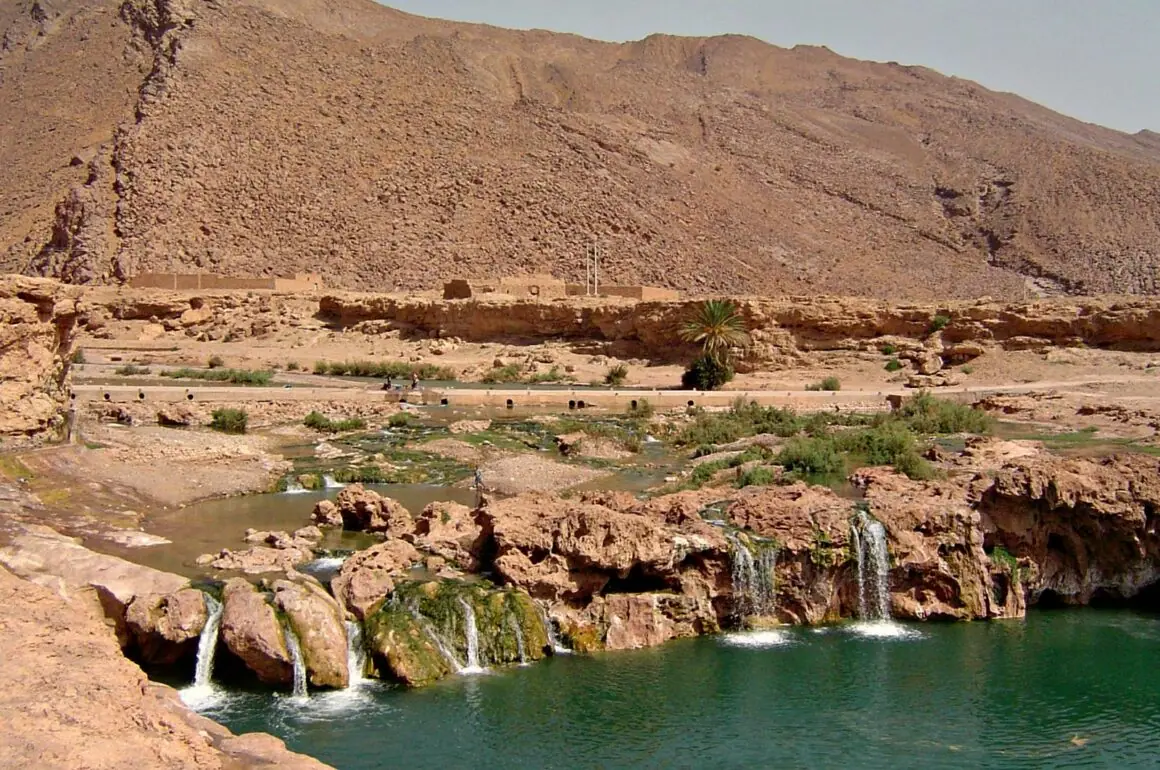
About an hour’s drive separates Foum Zguid from Tissint, on the road to Tata (which lies around 70 km away). The name is said to mean “salt” in Amazigh, because the oasis was known in caravan days for its brackish water. Visitors now come for the falls: a stroll along the banks, bare feet in the stream, and a swim in the natural basins.
There is more here than a dip:
- a palm grove and a small medina;
- the house where Charles de Foucauld stayed for several weeks, in the former Jewish quarter;
- a footnote for astronomers: the Martian meteorite that fell near the village in July 2011 carries its name.
Our Tissint waterfalls day out from Foum Zguid (from €90) includes tea in a Berber village, a short walk in a canyon and lunch beside the river, with a demonstration of tafernoute, a traditional bread. The flow is not constant: it depends on the season and recent rain.
Laarjimia: an oasis at the end of the Iriki piste
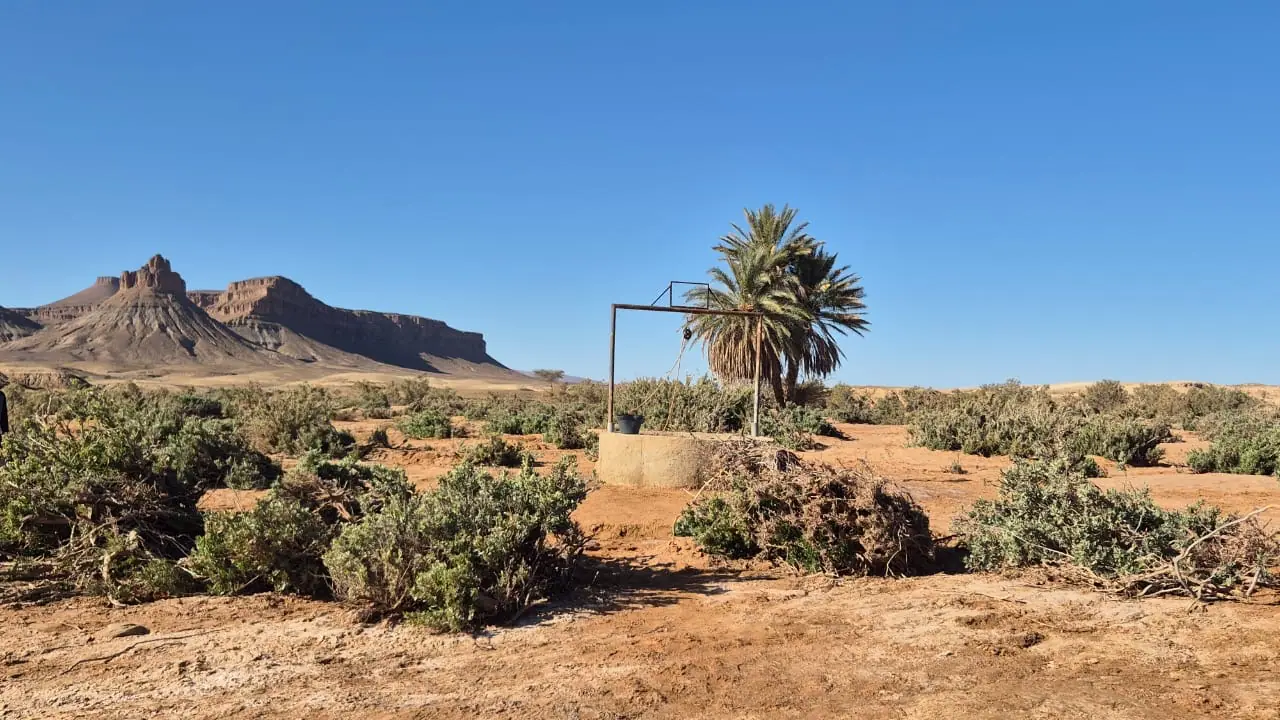
South of Foum Zguid, towards Iriki (Iriqui) National Park, oases shrink and drift away from everything. Laarjimia lies about 25 km along the piste. You cross ochre hills and flat-topped ridges; one summit of the Djbel Madouar El Kbir looks like the lid of a tagine.
On arrival the day is simple and slow: a wander among the date palms, a lunch cooked over a wood fire in the shade and, if you feel like it, a climb up a nearby hill to look down on the grove. That is the Laarjimia oasis excursion, from €80, the most affordable outing in our programme.
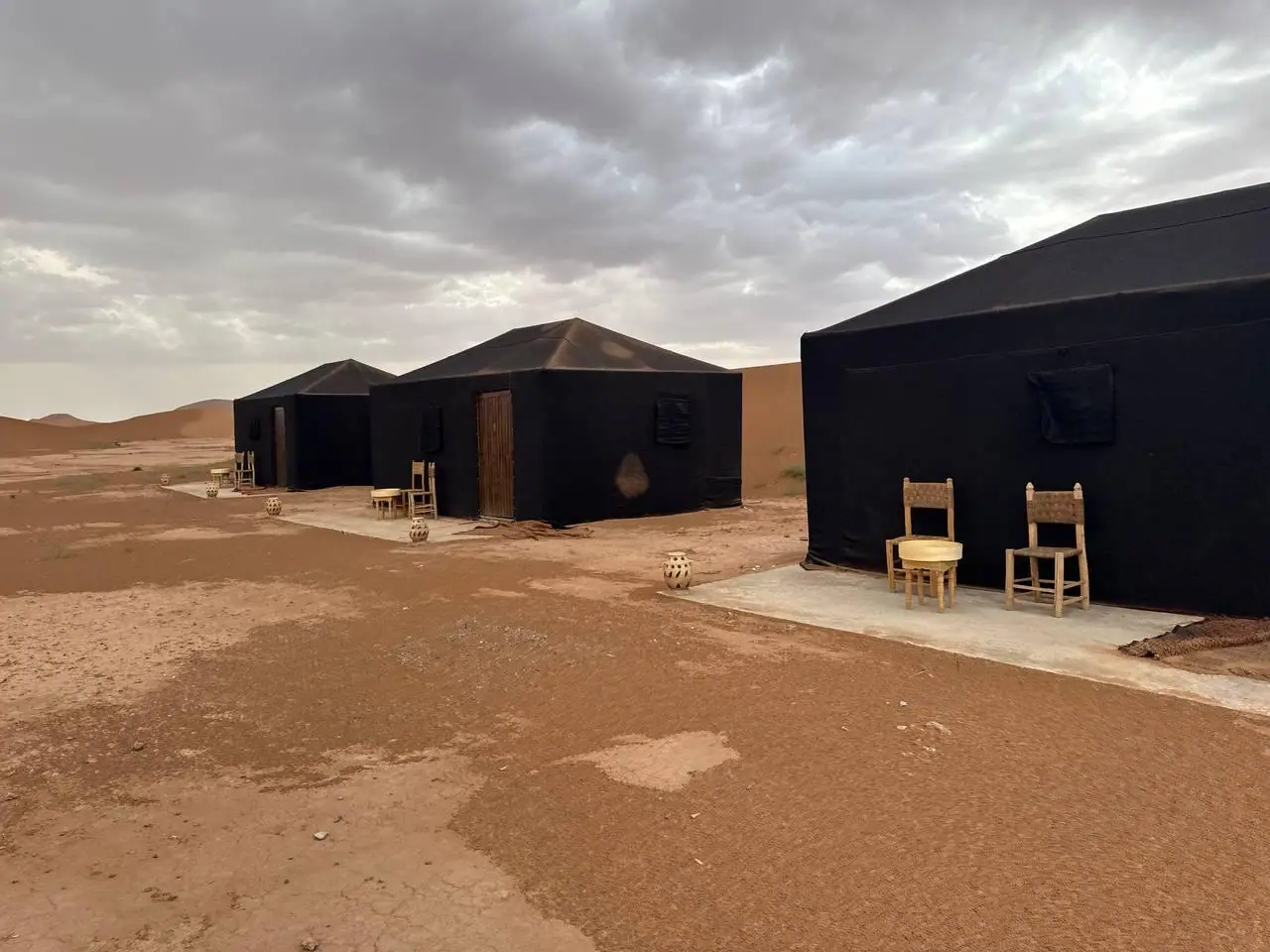
A two-day version, the Foum Zguid desert in 2 days and 1 night (from €120), adds a night in camp and calls at Zaouit Sidi Abdennabi and then the oasis of Laajamiya.
El Grisim: sleeping beneath the palms on the way to Chigaga
El Grisim is not a day-trip destination. It is a stage on our treks, roughly between Erg El Ghoule and Erg Chigaga (Chegaga): you arrive on foot beside the camels and the camp goes up among the trees. At dusk the light drops through the fronds, then come silence, a fire, tea and a sky thick with stars, far from any lamp.
The programme explains what an oasis is for, then you bake bread under hot sand and prepare the tea. Two walks lead here: over six days, the oasis to Erg Chigaga route (from €640); over five, the trek through the dunes (from €640). With a full week free, the trekking from Agadir (7 days, from €740) also stops here.
How water reaches the gardens: wadis, aquifers and khettaras
No water, no oasis. It may come from a wadi that flows for a few months, from a spring or from an underground reserve. To lead it to the plots, Moroccan farmers perfected the khettara, also written khattara or rhettara.
The idea is elegant: a gallery is dug underground at a gentler slope than the surface, so the water eventually emerges with no pump, simply by gravity. Vertical shafts at regular intervals are used to dig and then clean the tunnel. Elsewhere the same principle is called a qanat in Iran and a foggara in Algeria.
- The Drâa-Tafilalet and Marrakech regions have some, among other places.
- At Agadir Lehna, on the Tata side, you can see a khettara and a clepsydra, the water clock of old.
- For about thirty years many of these galleries have struggled, and a good number have been left to collapse.
The Drâa valley: the palm-grove road to M’Hamid
The Drâa is the kingdom’s longest river, at about 1,100 km. It begins where the Dadès and the Imini meet, and since 1971 the El Mansour Eddahbi dam has governed its flow. Beyond Tagounite its bed stays dry for most of the year.
The upper valley, about 200 km long, links six palm-grove clusters from Mezguita, near Agdz, down to M’Hamid El Ghizlane, with ksour by the dozen. It is one of Morocco’s best-known oasis itineraries, and Iriki National Park, south of Foum Zguid, reaches as far as the dry riverbed.
Two circuits connect the valley with the Chigaga dunes: one starts in Ouarzazate and runs via Zagora, Tamegroute and M’Hamid (Ouarzazate to Erg Chigaga via Foum Zguid, from €290); the other begins in Zagora (Zagora, Erg Chigaga and Foum Zguid, from €225). Both come home across Lake Iriki.
Which oasis trip suits the time you have?
Every departure is private, with a local driver-guide. From shortest to longest, here is what stops at an oasis:
| Length | Programme | Oasis stop | Starting at |
|---|---|---|---|
| 1 day | Laarjimia oasis | Laarjimia | €80 |
| 1 day | Tissint waterfalls | Tissint | €90 |
| 2 days / 1 night | Foum Zguid desert, 2 days | Zaouit Sidi Abdennabi, Laajamiya | €120 |
| 2 days / 1 night | Zagora, Erg Chigaga, Foum Zguid | Drâa valley, M’Hamid | €225 |
| 2 days / 1 night | Ouarzazate, Erg Chigaga via Foum Zguid | Drâa, Zagora, Tamegroute, M’Hamid | €290 |
| 4 days / 3 nights | Iriki National Park trek | Nomad oasis, Zouat Sidi Abdnabi | €300 |
| 5 days / 4 nights | Dune trek | El Grisim, night among the palms | €640 |
| 6 days / 5 nights | Oasis to Erg Chigaga trek | El Grisim | €640 |
| 7 days / 6 nights | Agadir to Chigaga trek | El Grisim, night among the palms | €740 |
All prices are per person and start “from”. To combine a palm grove and dunes in the least time, pick two days; for a night beneath the palms, you need a trek. Undecided? Browse our tours across the Foum Zguid desert, read the guide to trekking in the Moroccan desert or message us to book.
When to go and what to pack
The best window runs from October to April, when days are mild and walking between gardens is a pleasure. In summer the thermometer often passes 40 °C, so go out early in the morning or late in the afternoon. Winter nights in the desert can turn very cold, close to freezing, especially if you sleep in camp. In spring the wind can lift sand.
- water and sun protection;
- closed shoes for tracks and hills;
- a warm layer for the evening;
- small notes and coins for local purchases.
Fragile places: how to be a good guest
Southern Morocco’s oases face several pressures. Around Iriki National Park the regional tourism board records dunes advancing by roughly 20% in fifty years, at the expense of palm groves and channels. Drought and expanding cultivation draw on reserves that are often fossil water, and bayoud, a fungal disease of the date palm reported in Morocco as early as 1870, has not gone away.
A few habits genuinely help:
- keep to the paths: each garden has an owner and each channel its turn of water;
- do not pick dates or fruit unless invited;
- ask before photographing anyone, particularly women and children;
- use water sparingly in camp and guesthouses, as it often comes from afar;
- cover shoulders and knees in villages;
- spend locally: dates, cooperative crafts, a meal with a family;
- take your rubbish away, food scraps included.
Travellers’ questions
What exactly is an oasis in Morocco?
A farmed, watered space shaped by local people where water comes within reach, whether from a wadi, a spring or an aquifer. Date palms form the top layer, fruit trees the middle, and vegetables and cereals the ground. Earthen villages, the ksour, huddle around the gardens.
How does a khettara work?
Underground, a gallery leaves the water table at a gentler slope than the ground above, so the water emerges into daylight with no pump at all. Vertical shafts are used for upkeep. Khettaras exist in Drâa-Tafilalet, around Marrakech and, near Tata, at Agadir Lehna.
Which oases can I see from Foum Zguid?
The town’s palm grove can be walked on foot. After that come Tissint and its falls (about an hour towards Tata), Laarjimia (about 25 km of piste), Allougoum and its ksar (about 25 km north) and Zaouiat Sidi Abdenabi. As for El Grisim, you sleep there on the treks to Chigaga.
Is swimming possible at Tissint?
Yes, you can stroll the banks, cool down and swim in the natural basins. The water is salty, which gave the oasis its name among caravans. Bring modest swimwear and sandals, and ask about the water level beforehand: the flow changes with the season and the rain.
What does an oasis trip from Foum Zguid cost?
The Laarjimia oasis is offered from €80 per person for the day, the Tissint waterfalls from €90. The two-day desert trip, with lunch at Laajamiya oasis, starts at €120, and treks with a night at El Grisim at €640. The exact price is confirmed before any booking.
When should I visit the oases of the Moroccan desert?
From October to April, while days stay mild. In summer it is often hotter than 40 °C, so favour early morning or late afternoon. Winter nights in the desert can be cold. In spring a sandy wind may rise, so keep some flexibility in your plans.
Are Morocco’s oases in danger?
Yes: drought, falling water tables, neglected khettaras and creeping sand all weaken them. Around Iriki, the regional tourism board mentions dunes advancing about 20% in fifty years. Bayoud, a date-palm disease, has been recorded in Morocco since the 19th century.
Can I sleep in an oasis during the trip?
Yes, but only on a trek: at El Grisim the night is spent under the palms after a walk with the camels. Day trips to Laarjimia or Tissint head back in the evening. The two-day option includes a night in camp in the Foum Zguid desert.